










Maximizing Fitness: The Benefits of Sauna After Workout
Discover the significant benefits of a post-workout sauna session. From muscle recovery to stress relief, learn how saunas can boost your fitness regime.
Read
Thoughtful gifts
They keep putting off the warmth, the quiet, the hour that's just theirs — give them the reason to take back what they deserve.
Bath products
Your body has been waiting for this all week. The shoulders, the neck, the tiredness. This is what unknots them.
Aromatherapy
Coconut-soy candles, hand-poured. Roller blends carried in pockets and purses worldwide.
Natural skincare
Botanicals infused directly into the oil. USDA organic. Multi-oil carriers. Therapeutic aromatherapy.
Mindful living
Affirmation cards with a 30-second body practice on every card - not just words. Tapestries that change how a room feels, not just how it looks.
Sauna is one of the most-cited longevity practices in modern preventive medicine, with two decades of cardiovascular research behind it. A genuine daily sauna ritual — 4 to 7 sessions a week, eucalyptus aromatherapy during, a magnesium-salt soak after — is one of the more repeatable luxuries you can build into a week. The cabin you install determines whether that rhythm holds. We map the complete protocol, recommend the NOOK Cabin Sauna as the cabin engineered for daily use, and pair it with the Monsuri Eucalyptus Shower Spray + the body oil layering routine that turns the post-heat window into the part of the evening you look forward to.

A daily sauna ritual is one of the few wellness habits with two decades of clinical research behind it, but the experience is only as good as the cabin you walk into. The NOOK Cabin Sauna is what happens when an engineering team treats a 100°C wood-and-glass room as an architectural object rather than a backyard add-on. The Finnish HUUM 6 kW Estonian heater, the Canadian hemlock interior, the 80mm rock-wool envelope with vapour barrier, the EPDM roof rated at 50+ years, and the panoramic tempered-glass window facing your garden — every detail is calibrated for the rhythm the cardiovascular research used: 4-7 sessions per week, 15-30 minutes per session, at 80-100°C, year-round.
The HUUM heater is app-controlled. You tap "preheat" from your kitchen before dinner; by the time the table is cleared, the sauna is at 80°C waiting. That single capability — the removal of the 45-minute idle gap between intent and ready — is the difference between a sauna habit that lives at the edge of your week and one that lives inside it. NOOK's own engineering summary puts it dryly: "the HUUM app removes a friction layer that costs frequency."
Two hours from truck arrival to first session, professional install included. A 3-year direct warranty (no third parties). The base turnkey price is $52,920 in the US, with transport, foundation, electrical pre-wiring, and complete crane installation bundled. Optional upgrades — Millboard composite cladding for zero-maintenance 25-year exterior, red cedar interior, outdoor shower, screw-pile foundation — bring a fully loaded unit to the $80,000-$90,000 range. The lifespan: 25-30+ years residential, designed to outlast the structure most people put around it.
See NOOK Cabin Saunas → Read NOOK's Buyer Guide →

The clinical case for sauna use is one of the better-documented stories in modern preventive medicine, and most of the strongest research comes out of a single 22-year Finnish cohort study (the KIHD — Kuopio Ischemic Heart Disease Risk Factor Study) that tracked over 2,300 middle-aged men with regular sauna habits. The findings have since been replicated in mixed-sex cohorts and reviewed broadly in the medical literature.
What the research consistently shows:
The 2018 review in Mayo Clinic Proceedings summarised the KIHD cohort findings clearly: sauna bathing is "linked with several health benefits, which include reduction in the risk of vascular diseases." Both Cleveland Clinic and Harvard Health Publishing reference the same body of work in their patient-facing materials.
The Finnish protocol the studies used is specific and worth memorising: 4-7 sessions per week, 15-30 minutes per session, at 80°C to 100°C, followed by a cool-down. That's the dose. Stanford's Andrew Huberman, summarising the same evidence in his deliberate heat exposure newsletter, recommends 57°C and above and the same 4-7 session frequency for measurable cardiovascular and growth-hormone benefit. The temperature threshold matters — this is why the heater quality and insulation envelope discussion in §1 is not a marketing point. It's the variable that determines whether you reach the dose, session after session, week after week. The NOOK cabin sauna (HUUM heater, 80mm rock-wool envelope, EPDM roof) is engineered around that exact protocol.
A note on framing, since wellness writing too often skips this: nothing in this article is a treatment recommendation or a substitute for medical advice. The studies cited measured statistical association in cohorts; they do not promise individual outcomes. Anyone with cardiovascular disease, pregnancy, low blood pressure, or active illness should consult a physician before starting a sauna ritual.
A sauna by itself is hardware. A sauna ritual is what turns that hardware into a daily habit. The three-layer structure is what most protocol summaries skip — they teach you what to do during the session but stop short of the preparation and the recovery. The before-and-after is where the routine lives.
The structural anchor: 15 minutes of prep, 15-25 minutes in the sauna, 30 minutes of recovery. About an hour, four to five evenings a week. Think of it as the wellness equivalent of an evening workout — the work is in the consistency, not the intensity. (Our post-workout sauna pillar covers the strength-training pairing if you want it.)

Eucalyptus is the oil sauna users return to. Every wellness retailer in the category recommends it first, and the reason isn't taste preference — it's that eucalyptol (1,8-cineole), the primary compound in eucalyptus essential oil, has measurable anti-inflammatory and bronchodilatory effects when inhaled, well-documented in peer-reviewed literature. In a sauna, where the temperature opens the airways and increases the volume of air you're moving through them, the eucalyptus is doing what it does at any temperature — just more effectively.
The application protocol is uniform across every reputable source: 5 to 10 drops of pure eucalyptus essential oil added to a ladle of water, then poured slowly over the heated sauna stones. Never drop pure oil directly on the stones. It produces a harsh, acrid vapor at full concentration that's unpleasant to inhale and degrades the active compounds. Diluted in water, the eucalyptus carries through the steam evenly for the next 8-12 minutes — long enough to fill the cabin without overwhelming it.
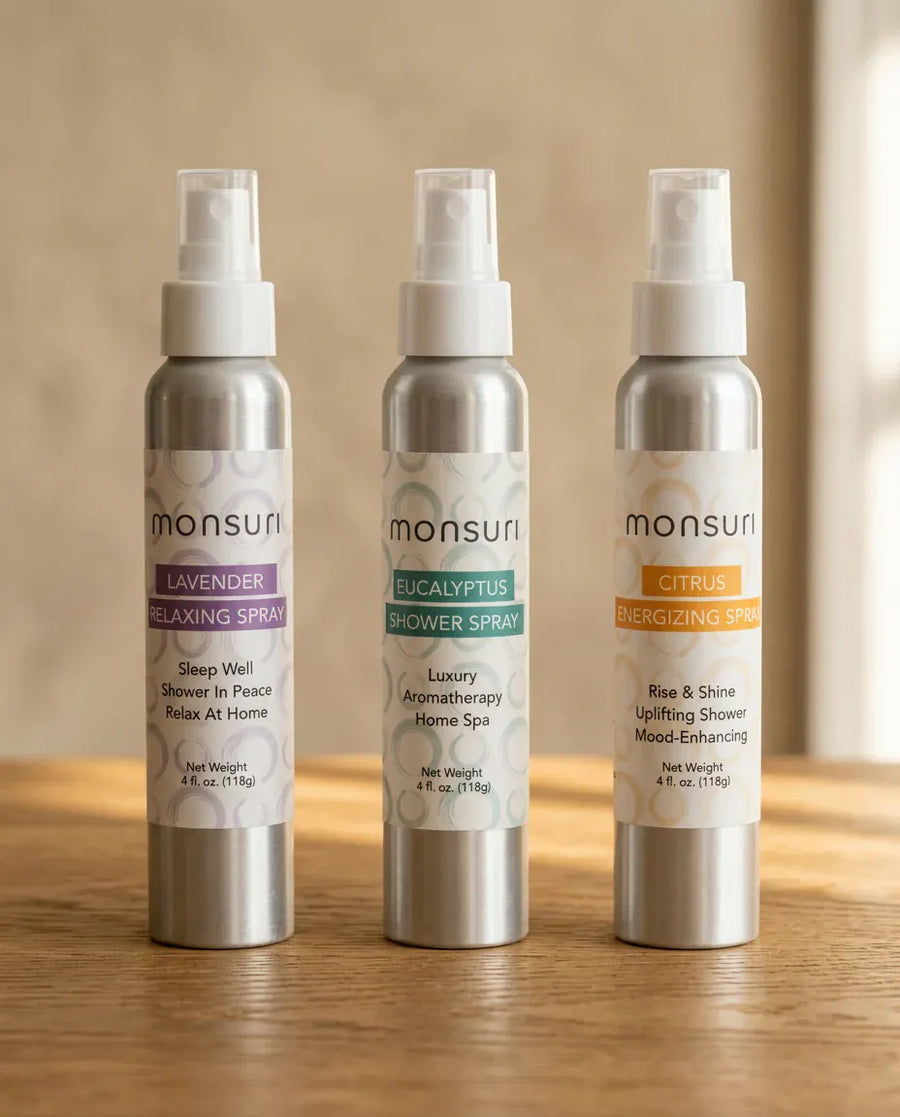
If you don't want to invest in a separate bottle of essential oil that lives only in the sauna, our Eucalyptus Shower Spray ($29.95) works as a portable alternative. The 100% organic eucalyptus + peppermint blend was originally designed for the shower — one of our customers, MJBurroughs, writes: "This is the time of year for stuffed noses. Having a spray like this helps even more. Clears my sinuses." Another, Heber Cloward, told us: "I also spray it around my bed just before going to bed to help clear my sinuses." The same bottle works in three contexts: in the shower, sprayed lightly into the sauna vestibule before entering (not on hot surfaces directly), and on your pillow after. Eucalyptus + heat is a consistent sensory pairing, wherever the heat comes from.
For variety, the post-workout combination most aromatherapy sources recommend is 5 drops eucalyptus + 3 drops peppermint, which adds a sharper top-note and a mild cooling sensation as the steam clears. Pine, birch, and cedarwood work too; lavender skews softer and is better in the post-sauna soak than during the session itself. Pregnant or breastfeeding sauna users should consult an HCP before using any essential oil; children under 6 should not be in a session with oils present at all.

The 30 minutes after you step out of the sauna is when the work actually happens. Your core temperature is still elevated. Blood is still pushed toward the skin's surface, where the heat shed during cooling lifts dead skin and opens pores. Magnesium — particularly when absorbed through warm water on warm skin — is taken up more readily than at any other time in the day. And body oil applied to skin that's still damp from a magnesium soak holds for hours instead of minutes.
Most home sauna protocols stop at "drink water and cool down." That's the minimum. The full recovery layer adds two specific moves:
If your sauna is part of a post-workout recovery routine specifically, you can swap the lavender for our Warm-to-Cool Muscle Recovery Oil, which adds arnica and menthol to the carrier-oil base. The arnica is a topical anti-inflammatory; the menthol gives the warm-to-cool sensation that signals to your nervous system that you're winding down. Either way, the layering pattern is the same: bath salts in warm water, oil on damp skin, no rush.

If you're still researching the cabin-vs-barrel question, the choice maps cleanly to intended frequency. We won't try to outwrite NOOK's own 17-minute buyer guide — it's the most thorough technical write-up of the question available, with 19 footnoted sources. Read it. Below is the headline summary so the ritual sections above have their hardware context.
| Attribute | Barrel sauna | Premium cabin (NOOK) |
|---|---|---|
| Heater | Entry-level electric or wood-burning, manual dial | HUUM 6 kW Estonian, app-controlled |
| Max temperature | Typically 70-85°C | True 100°C löyly |
| Heat-up time | 60-90 min | ~45 min year-round |
| Interior wood | Cedar, single-layer | Canadian hemlock (no resin bleed) + optional red cedar upgrade |
| Insulation | None or minimal | 80mm rock wool + vapour barrier |
| Install time | 1-2 days DIY | Under 2 hours professional crane install (US) |
| Lifespan | 5-15 years residential | 25-30+ years residential |
| Warranty | 1-2 years typical | 3 years (NOOK direct, no third party) |
| Price US (fully installed) | $5,000-$8,000 | $52,920+ turnkey |
The honest framing: a barrel sauna is the right choice if your intended usage is occasional — a few times a month, mostly in warm weather, on a small budget, with replacement accepted within a decade. A premium cabin is the right choice if you intend the 4-7-sessions-a-week rhythm the Finnish data documents, want year-round consistency across any climate, and treat the install as a 25-30 year architectural investment rather than a backyard add-on. NOOK's verdict in their own guide: "Three models, one standard: premium."

The sauna category for US hospitality operators is shifting fast. RLA Global's 2025 industry analysis (cross-referenced with HotStats) measured a +22% RevPAR and +18% ADR lift at major-wellness hotels versus no-wellness comparables. Per CBRE's 2025 hotel benchmark, full-service spa programs deliver +12-18% RevPAR. At the boutique end, 56% of revenue at major-wellness hotels now comes from non-room (wellness) spend — the sauna is increasingly the anchor amenity in that mix.
For US vacation-rental operators, AirDNA's 2024-2025 short-let data shows a +7.4% ADR uplift on sauna-equipped listings versus comparable non-sauna properties — rising to +9.4% in rural and small-town markets where the amenity is more differentiated. Wellness retreats and glamping operators have followed: 64% of new hospitality spaces listed in the last two years included some form of outdoor bathing; 85% among the top-performing properties.
The operating economics matter more for hospitality than residential. A NOOK Cabin Sauna's Energy Rating A envelope means $1-3 per hour of operating cost, and the 25-30+ year lifespan handles the daily commercial cycling that ends most home-grade saunas in 12-18 months of resort use. The 3-year direct warranty + 2-hour install + Finnish-engineered heater translate into a turnkey amenity, not a construction project. NOOK's published portfolio case study on a 5-pod luxury glamping site: roughly $40,000 annual revenue uplift against an installed cost of $50,000-$65,000 across the portfolio — a 14-22 month payback, with the amenity expected to drive uplift across the 25+ year asset life.
NOOK for hospitality operators → Request a NOOK quote →

If you've made it through the protocol and you have access to a sauna (yours or otherwise), here is a steady on-ramp from twice a week to the Finnish four-to-seven cadence:
The NOOK app-controlled preheat is what lets that rhythm survive a busy week — tap your phone before dinner, the cabin is at temperature by the time you've cleared the table. The magnesium-and-oil layer is where the recovery deepens; the late-week sessions feel measurably different from the early-week ones once the ritual is in.
Build your sauna ritual with NOOK →
Already have a sauna? The same ritual works regardless — the eucalyptus spray, magnesium salts, and lavender body oil are the daily layer.
Continue your ritual
One more read. One thing for the bath.