




Affirmation Cards, Explained: What They Are and How to Use Them

Affirmation cards are a deck of cards, each printed with one short, positive statement — "I am enough," "I can handle hard things," "I choose calm" — that you read, usually aloud, to interrupt the negative loop already running and reinforce a belief you're choosing on purpose. That's the whole idea. The more interesting questions are the ones the packaging never answers: do they actually work, when do they backfire, and how do you use a deck so it becomes a habit instead of a drawer decoration. Below is the honest version, with the research attached. If you already know you want a deck, our daily affirmation cards pair each line with a 30-second ritual; if you're here to understand the practice first, start with what self-love actually means.

  • What they are: a deck of short positive statements you read daily to redirect self-talk.
  • Do they work: yes, modestly — a 2023 review of 144 self-affirmation studies (mostly values-writing exercises) found a small but real positive effect (Escobar-Soler et al., 2023). It lands best when the statement feels believable, not aspirational to the point of disbelief.
  • The catch: a card you don't believe can backfire, especially if your self-esteem is already low (Wood et al., 2009).
  • The fix Monsuri builds in: every Positive Vibes card pairs the affirmation with a 30-second action on the back — so you do the belief, not just say it.
Affirmation cards meaning — Infographic: how affirmation cards work — name the thought, read the card, do the 30-second ritual on the back, repeat daily.
How a card actually shifts self-talk: name the thought, read the card and do the small action, repeat.

Here is that graphic in words, because it's the core of the whole practice. An affirmation card works in three moves. First, you name the thought — you catch the anxious or critical line already running in your head ("I'm going to blow this"). Second, you read the card and do the ritual — you say the affirmation out loud, then do the small physical action many decks print on the back: a slow exhale, a splash of cold water, shoulders down and back. Third, you repeat it daily. Pairing the words with an action is what many people find turns a nice sentence into a habit rather than a wish — it's why Monsuri prints a 30-second ritual on the back of every card, a design choice rather than something the studies below set out to measure. Those studies test self-affirmation more broadly: across 144 trials, most of them brief values-writing exercises, a 2023 review found a small but statistically real positive effect (Escobar-Soler et al., 2023).

What are affirmation cards?

An affirmation card is a single card carrying one short, first-person, present-tense statement — "I am worthy of rest," "I speak up for myself," "I am steady." A deck collects 30 to 60 of them, usually sorted into themes like gratitude, confidence, or calm. You draw one, read it, and let it set a small intention for the day. Most people keep a deck somewhere they'll see it: propped on a bathroom mirror, on a desk, on a nightstand.

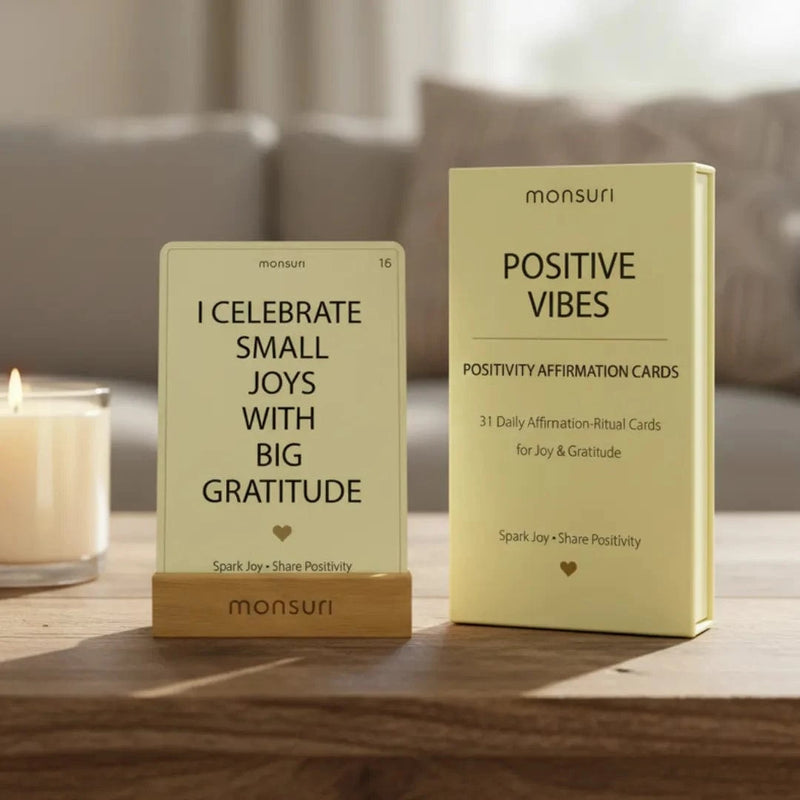
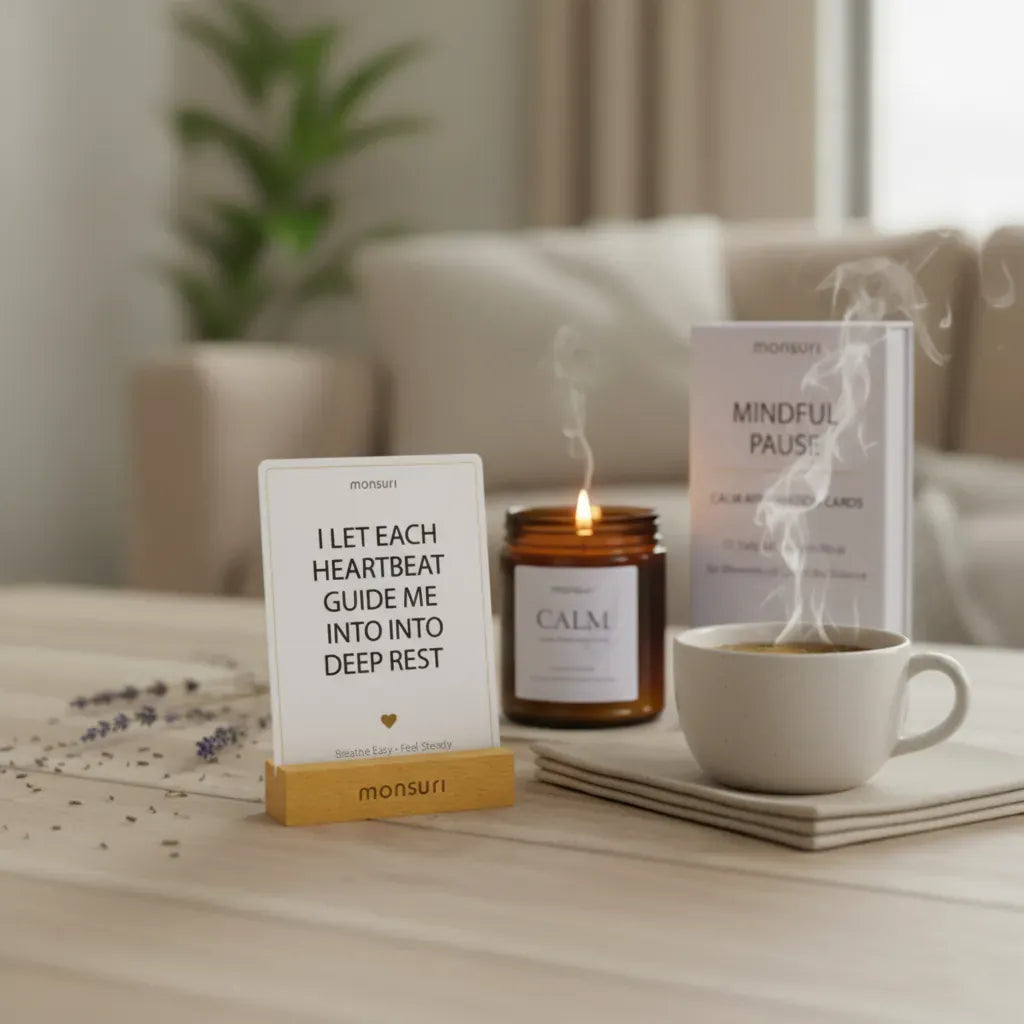
The better decks do one more thing. A Monsuri Positive Vibes deck, for example, is 31 dual-sided cards (3.5" × 5") with the affirmation on the front and a 30-second ritual on the back — "set a timer for five minutes, sit outside, notice the small sounds" — plus a small wooden stand so a card can sit in view all day. The card is the reminder; the ritual is the part that does the work. That distinction matters more than it sounds, and it's exactly where the research lands next.

Do affirmation cards actually work?

Short answer: yes, modestly, and only if you use them a certain way. This is the part almost no affirmation-card page will show you with real citations, so here it is.

Affirmation cards meaning — Do affirmation cards work? Self-affirmation research (mostly values-writing) shows a small but real effect (d = 0.41 across 144 studies), reward-region activity, and lower stress.
What the research says about whether affirmation cards work: a small but real effect, not magic.

The practice sits on top of self-affirmation theory, introduced by psychologist Claude Steele in 1988 — the idea that reminding yourself of what you value protects your sense of being a capable, good person when something threatens it. Decades of studies followed. A comprehensive review in the Annual Review of Psychology found that brief values-affirmation exercises can improve outcomes in education, health, and relationships, with some effects lasting months or longer (Cohen & Sherman, 2014).

Three findings are worth knowing by name:

  • It shows up in the brain. An fMRI study found that when people reflected on their core values, activity increased in the ventral striatum and ventromedial prefrontal cortex — regions tied to reward and self-processing — and that response predicted real behavior change afterward (Cascio et al., 2016).
  • It buffers stress. In a lab study, people who wrote briefly about a personal value before a stressful task showed lower cortisol responses than those who didn't (Creswell et al., 2005).
  • The real-world effect can be large. In a field study, middle-schoolers who wrote a 15-minute values-affirmation essay saw a persistent grade improvement — the racial achievement gap in that group shrank by about 40% over the term (Cohen et al., 2006).

Two honest caveats. Most of this research studies values-affirmation — writing about what matters to you — not literally reading "I am amazing" off a card, so a deck is a lightweight, daily cousin of the studied practice, not the exact thing. And the averaged effect is small, not magic. Affirmation cards are a nudge that helps a real habit form; they are not a treatment for anxiety, depression, or any medical condition, and nothing here should replace care from a professional.

Affirmation cards meaning — Monsuri Positive Vibes affirmation cards — 31 dual-sided cards with an affirmation on the front and a 30-second ritual on the back, plus a wooden stand.
Positive Vibes: 31 cards, each with a small ritual on the back — the pairing that makes an affirmation stick. Shop Positive Vibes →

Can affirmation cards backfire?

Yes — and this is the part the cheerful listicles skip. In a well-known set of experiments, people with low self-esteem who repeated a positive self-statement like "I am a lovable person" ended up feeling worse, not better, than people who didn't repeat it (Wood et al., 2009). When a statement is too far from what you currently believe, your mind pushes back and lists all the evidence against it. The card meant to lift you becomes one more thing you're failing at.

Affirmation cards meaning — Why generic positive affirmations can backfire — for low self-esteem an untrue statement feels worse; pick a reachable line and pair it with an action.
The honest catch: a generic positive affirmation can backfire when it feels untrue — the fix is a believable line plus a small action.

The fix is not to abandon the practice — it's to make it believable. Three adjustments, all supported by how the research shakes out:

  • Choose reachable statements. "I'm learning to trust myself" lands when "I trust myself completely" bounces off. Pick the card that's a half-step ahead, not a fantasy.
  • Anchor it to a value, not a mood. "I care about showing up honestly" is harder to argue with than "I feel confident," because it's about what you value, not how you happen to feel today — which is closer to what the studies actually tested.
  • Pair it with an action. Doing a small thing while you say the line — one slow breath, a cold splash, standing tall — can make the words feel less abstract and easier to sit with. It's why Monsuri decks print a 30-second ritual on the back of every card instead of leaving you with the sentence alone.
An affirmation you only read is a wish. An affirmation you pair with a breath or a cold splash of water is a rep — and it's the reps, not the reading, that tend to stick.

How to use affirmation cards, day to day

You don't need a system. You need a cue you already have and a card in view. Here's the version that survives a busy week:

  1. Attach it to something you already do. Draw a card while the coffee brews, or right after you brush your teeth. The existing habit is the trigger; the card rides on top of it.
  2. Read it out loud, once. Many people find saying it aloud makes it harder to skim past — try it and keep it if it helps.
  3. Do the 30-second ritual. One breath, one stretch, one splash of cold water. It's the step most people skip — and the one that turns reading into doing.
  4. Leave it where you'll see it. Stand the card on the mirror or the desk so it keeps working after you've walked away. A cue you can see is a cue you keep.
  5. Give it a few weeks. Habits form on repetition, not intensity. A card a morning for a month beats an hour of affirmations once.

If mornings are chaos, pick a different anchor — the drive home, the moment before bed. The point isn't the perfect time. It's the same time, most days. For a broader routine to hang it on, our guide to carving out real me-time covers where a two-minute practice like this fits.

Which affirmation cards are right for you?

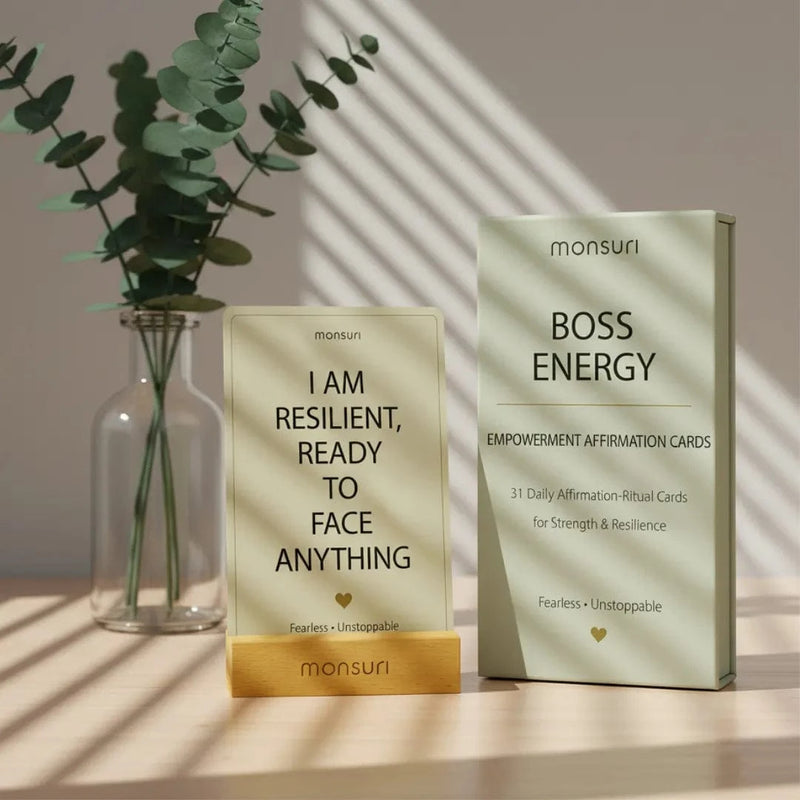
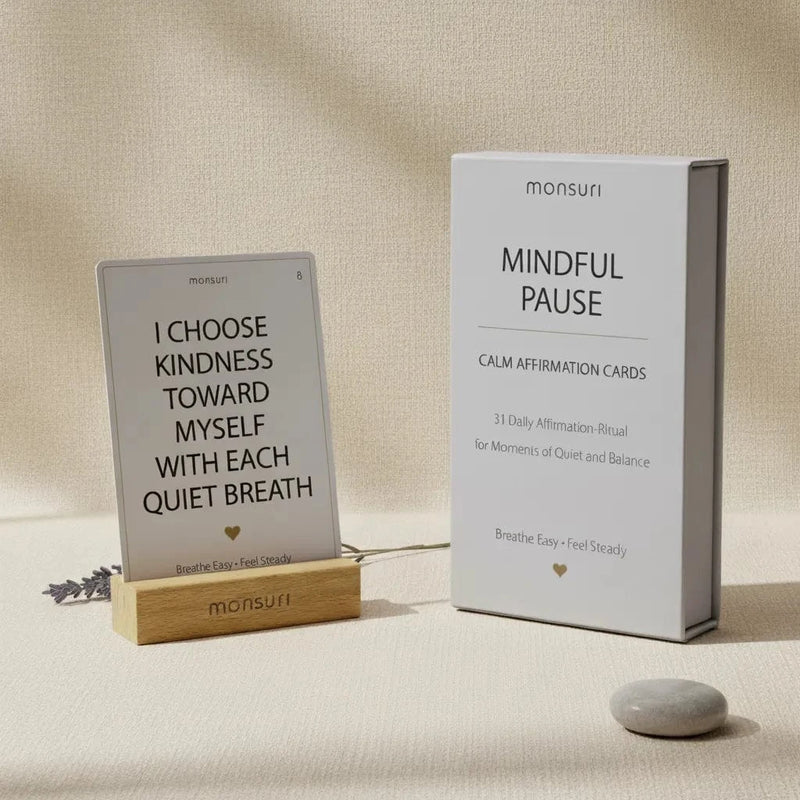
The best deck is the one that matches the thought you're trying to interrupt. A confidence prompt and a calming prompt suit different moments — the one you reach for before a presentation isn't the one you reach for when your mind is busy at midnight. Pick the deck whose prompts feel relevant to where you are. Monsuri makes four, each 31 dual-sided cards with a ritual on the back and a wooden stand, so you can pick by the moment you're in:

Deck Best for The ritual style Price
Positive Vibes Everyday positivity & self-love Joy & gratitude prompts $26.90
Mindful Pause Busy-mind, stressful moments Breath-based grounding $26.90
Boss Energy Confidence before big moments Quick embodied power moves $26.90
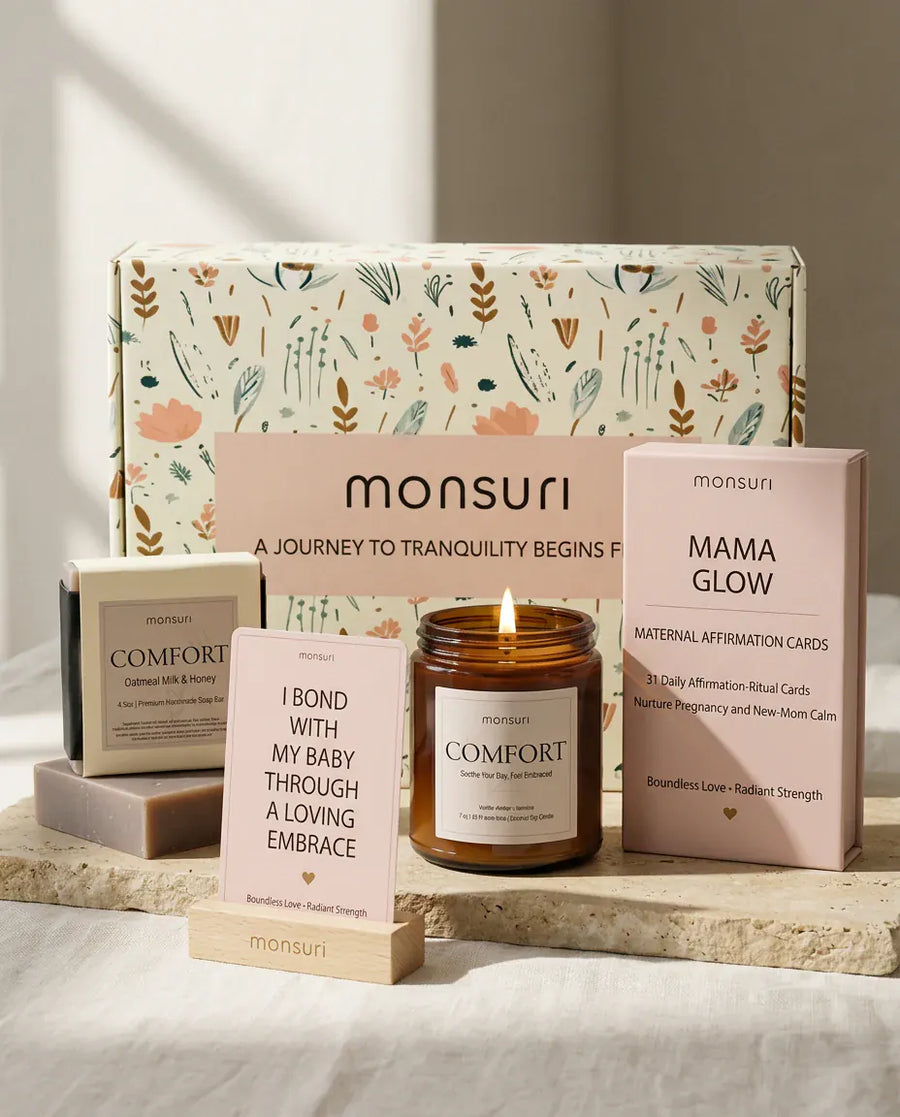
Mama Glow Pregnancy through new motherhood Permission & grounding $26.90

Not sure, or buying for someone else? Our self-care gift guide has more ideas if you're shopping broader, but the whole affirmation cards collection is one place to compare them, and the three-deck Affirmation Card Trio (Positive Vibes + Boss Energy + Mindful Pause) covers most moods for a person who's new to the practice. If it's a gift, the Positivity Boost Gift Set wraps the deck with a citrus shower spray and a sugar scrub — the sensory version of the same morning ritual. Whichever you choose, these decks are reflective keepsakes — a daily prompt to pause — not a treatment for anxiety or any medical condition.

Affirmation cards meaning — Monsuri Positivity Boost Gift Set — the Positive Vibes affirmation cards with a citrus shower spray and a sugar scrub, arriving gift-ready.
The gift version: the deck plus a citrus spray and scrub. One reviewer, Lulu, sent it to a new mom and called it "clean, simple and heartwarming." Shop the gift set →

Simple ways to make the habit stick

The failure mode isn't the cards — it's forgetting they exist. A few low-effort moves keep a deck in the rotation:

  • Keep it where the thought happens. A worry that surfaces at night? Nightstand. Nerves before work? Bathroom mirror. The stand exists so the card stays upright and visible.
  • Rotate, don't ration. Draw a new card when the last one stops landing, not on a schedule. When one really fits, keep it out for a week.
  • Say it, then move. Reading is passive; the 30-second action is the part that tends to stick. Skip it and you've read a nice sentence.
  • Pair it with self-care you already like. A card and a candle, a card and a warm shower. Short on lines to rotate in? Our 50 quotes for self-care and reflection work well as cards too.

Affirmation cards aren't a personality transplant or a cure for a hard week. They're a small, repeatable way to catch the story you're telling yourself and offer a truer one — with a breath attached so it counts. Pick the deck that matches your loudest thought, keep it in view, and say it like you're practicing, not pretending. Browse the affirmation card decks when you're ready. Start with one card tomorrow morning. You're allowed to talk to yourself kindly.

Frequently asked questions

What are affirmation cards?

Affirmation cards are a deck of cards, each printed with one short, positive, present-tense statement — like "I am enough" or "I choose calm." You draw one, read it (usually aloud), and let it set a small intention. Better decks add a short ritual on the back so you do the belief, not just say it.

Do affirmation cards actually work?

Modestly, yes. A 2023 review of 144 self-affirmation studies — mostly brief values-writing exercises — found a small but statistically real positive effect, and fMRI research links the practice to the brain's reward and self-processing regions. It works best when the statement feels believable. Cards are a lightweight daily cousin of that research and a nudge that helps a habit form, not a treatment for any condition.

Can affirmation cards backfire?

They can. Research (Wood et al., 2009) found that people with low self-esteem who repeated a positive statement they didn't believe felt worse, not better. The fix is to choose reachable statements, anchor them to a value rather than a mood, and pair each one with a small action so it feels true.

How do you use affirmation cards?

Attach it to a habit you already have — draw a card while the coffee brews. Read it out loud once, then do a 30-second ritual (a slow breath, a cold splash, shoulders down). Leave the card in view, and repeat most days. The action step is the one most people skip — and the one that turns reading into doing.

How often should you use affirmation cards?

Daily, one card, for a few weeks. Habits form on repetition, not intensity — a card each morning for a month does more than an hour of affirmations once. Draw a new card when the last one stops landing rather than on a fixed schedule.

Are affirmation cards a good gift?

They make a thoughtful one, matched to the person's moment — Mindful Pause for someone who likes grounding prompts in stressful times, Boss Energy for a new job, Mama Glow for a new mom. They're reflective keepsakes, not treatments for any condition. The Positivity Boost Gift Set wraps the deck with a citrus shower spray and a sugar scrub for a ready-to-give version.
— One deck for every mood —

Three decks for the day, the doubt, and the 3 a.m.

Positive Vibes, Boss Energy, and Mindful Pause — bundled below, or pick the one that matches your loudest thought.

—Bundle—

The Affirmation Card Trio

$80.70
From our workshop to your bath
By Monsuri
Small-batch, made in the USA. Written without a hurry.