


Sugar Scrub for Body: How to Pick One (Grain, Oil, Cost)

A sugar scrub is granulated sugar suspended in oil: the sugar lifts off flaking surface skin, the oil stays behind so you do not step out tight. What separates a good jar from a bad one comes down to four checkable things — the grain, the oil base, whether it rinses or coats your tub, and what it costs per use rather than per jar. The single most useful fact about sugar is that it dissolves while you work, so the scrubbing gets gentler the longer you go. Salt does not do that. It keeps its edge from the first pass to the last.

Worth knowing before you shop: in our own order history, almost nobody bought the scrub on its own. Of twenty-five sugar-scrub orders, only two were the scrub by itself — the rest arrived in a basket, most often alongside a body butter. Buyers pair the scrub with something to seal afterwards without anyone telling them to, which happens to be exactly what dermatologists advise. If you want the technique rather than the shortlist, our guide to using a body scrub covers application and order-of-operations. This page is about choosing one.

  • Sugar dissolves as you scrub; salt does not. That self-limiting abrasion is why sugar suits most body skin and salt suits calloused feet — see the full range of scrubs and butters.
  • A second, non-dissolving grain changes what the jar can do. Our Lemongrass & Ginger Sugar Scrub ($16 / 2.5 oz, $28 / 5 oz) carries poppy seeds as a second, finer grit that catches rough spots after the sugar has softened them.
  • The oil base decides what you are left standing in. A scrub built on coconut oil alone turns solid below 77 °F and films the tub; a grapeseed and baobab base stays pourable.
  • Price the jar per use, not per jar. A 5 oz tub at two or three uses a week runs about six weeks — roughly $1.55 to $2.35 a scrub, depending how often you go.
  • Two or three times a week suits most people — but the American Academy of Dermatology's actual rule is to match frequency to your skin and method, not to a fixed number. It warns that over-exfoliating leaves skin "red and irritated," and says to moisturize immediately afterwards.
A woman holding the 5 oz jar of Monsuri Lemongrass and Ginger body sugar scrub against her shoulder, the label reading body sugar scrub, lemongrass and ginger, net weight 5 oz.
The 5 oz jar — the size the cost-per-use maths is built on. Compare the full range of scrubs →

What a sugar scrub is, and what it does to your skin

A body sugar scrub is a physical exfoliant — sugar crystals carried in oil. You work it over damp skin and the crystals lift away the loose, dulling layer of surface cells that soap alone leaves behind. Mechanical exfoliation is the oldest version of this idea, and sugar is a forgiving way to do it.

Sugar is sucrose, and sucrose is water-soluble. That one property is the whole argument. The moment sugar meets wet skin it begins to melt, so a scrub that starts as noticeable grit finishes as something closer to a slippery oil. Ten or fifteen seconds of slow circles and the abrasion has already tapered off on its own. That does not make it impossible to overdo — how hard you press and how long you keep going still matter — but the grit is working against you for less of the time than salt would.

What you should not expect: a sugar scrub is a surface treatment. It smooths texture and it leaves oil behind. It is not doing anything to the deeper layers of your skin, and any page telling you a pantry ingredient pulls toxins out through your pores is selling you something worse than a scrub.

Sugar or salt? The comparison nobody on page one writes

This is the first real fork, and it is strangely hard to find answered. Search it and you mostly get recipes for making your own, or a grid of jars to buy — very little that tells you which of the two you actually want. So here is the honest side-by-side.

Sugar scrub versus salt scrub chart: sugar has rounder facets and dissolves as you scrub so abrasion tapers off, best on arms and legs; salt stays sharp start to finish, best on heels and calloused patches.
The whole fork in one frame: sugar dissolves as you work, salt does not.
  Sugar scrub Salt scrub
Crystal edge Rounder, softer facets Sharper, more angular
As you scrub Dissolves — abrasion tapers off by itself Holds its edge start to finish
Best on Arms, legs, chest, back — most body skin Heels, soles, heavily calloused patches
Skip it when Skin is broken or sunburnt Same, and straight after shaving — salt stings longer
Left behind A film of oil; skin feels soft Oil plus mineral residue; can feel squeakier

The short version: pick salt if you are attacking one stubborn, thickened patch, and sugar for everything else. If you want the exfoliation in bar form instead of a jar, our Lemon Zest Scrub Soap ($9.50) uses sea-salt crystals in a soap base — the coarser end of the same idea.

The four things that separate a good jar from a bad one

Sugar scrubs look identical in a product grid. These four differences are the ones you can check before you buy, and the ones you will notice afterwards.

1. Grain size — and what a second grain changes

Coarse sugar bites harder and quits sooner. Fine sugar is gentler but can feel like it never really did anything. Most jars pick one and live with the compromise.

Pairing two grains lets one jar do both jobs. Ours pairs granulated sugar with poppy seeds: the sugar does the broad work and softens the rough patches, and the poppy seeds — which do not dissolve — stay behind as a fine grit to catch what the sugar loosened. The sugar tapers off; the seeds keep working. Check the ingredient list for a second textural element before you buy: a single-grain jar is doing one of those jobs, not both.

An open jar of Monsuri Lemongrass and Ginger body sugar scrub on a wood slice with eucalyptus leaves, the pale granulated sugar visibly flecked with dark poppy seeds — the second, finer grit.
Two grains in one jar: pale sugar, and the dark poppy seeds that keep working after the sugar has dissolved. Shop the sugar scrub — $16 / $28 →

2. The oil base — what it leaves behind

This is the criterion nobody frames as one, and it is the one most likely to disappoint you. Every scrub is mostly oil by volume, and the oil is what you are still wearing an hour later.

Coconut oil used on its own is the default in homemade and budget jars, and it has a specific problem: it is a white solid below roughly 25 °C (77 °F). In a cool bathroom the jar sets hard, and when it does melt it tends to film the tub floor. A blend fixes this. Ours carries the sugar in grapeseed, coconut and baobab seed oils, which stays scoopable at bathroom temperature rather than setting into a puck.

The related question is greasiness. It is the thing our own customers raise first about any oil-based product, usually unprompted — and it is a fair worry, because a scrub that leaves a slick is a scrub you stop reaching for.

3. Cost per use, not sticker price

Jar prices in this category run from about $13 to $38, and the number on the label tells you almost nothing, because the jars are different sizes and get used at different rates. Do the arithmetic once.

A 5 oz tub used two or three times a week lasts roughly six weeks — call it twelve to eighteen scrubs. At $28 that is somewhere between $1.55 and $2.35 a scrub, depending how often you go. The 2.5 oz jar at $16 works out slightly higher per scrub, which is the usual trade for a smaller commitment. Run that same sum on any jar you are considering; a cheap tub you burn through in three weeks is not the bargain it looks like.

4. Does it rinse, or does it coat your tub?

The most-cited complaint across our oil-based bath products — not this scrub, which has only two reviews to its name — is not the product at all. It is the cleanup. One customer put it plainly: "having to clean up the detritus post-bath undoes all the relaxing effects of the bath itself."

An emulsified scrub is the answer. Emulsified means the oils are formulated to lift and leave with the water instead of separating out and settling on the enamel. Ours is built that way, so the oils rinse off rather than coating the tub. One honest caution either way: oil on a wet floor is slippery, so mind your footing on the way out.

Match the scrub to the job

Once you know the four criteria, the choice is mostly about what you are scrubbing and how often.

Sugar scrub decision diagram: arms and legs take a medium grain two or three times a week, elbows and heels take a heavier pass with the same jar or a coarser salt bar, easily reddened skin scrubs once a week at most.
A decision diagram for the three commonest cases — same jar, different pressure.
  • General smoothing, arms and legs, two or three times a week — a medium-grain sugar scrub on a light oil blend. This is the default and it is what most people want.
  • Rough elbows, knees and heels — go heavier in those spots with the same jar, where the poppy seeds keep working after the sugar has melted. For a callus thick enough to catch on a towel, that is the one job worth a coarser salt bar.
  • Dry, easily-reddened skin — scrub less often, not more gently-but-daily. The AAD notes that mechanical exfoliation "may be too irritating" for dry or sensitive skin, so once a week is a sensible ceiling and a washcloth may suit you better.
  • Prepping for a shave or a self-tan — scrub the day before, not the same hour. Freshly exfoliated skin is more reactive, and an even surface takes color more evenly.

What about making your own?

Half the results for this search are homemade recipes, and they are not wrong. The standard ratio is about two parts sugar to one part oil — a cup of sugar to half a cup of coconut oil — and if you want a scrub for this weekend, that works.

Diagram of why a homemade sugar scrub stops working by week three: shower splash dissolves the sucrose to syrup, a pantry recipe has no preservative, and coconut oil sets solid below 77 degrees Fahrenheit.
The part the recipe posts leave out: a diagram of what the jar is like three weeks later.

What those recipes leave out is what happens to the jar afterwards, and it is worth knowing before you commit a Saturday:

  • Water gets in. A jar living on the edge of a wet shower takes on splash and steam, and sucrose dissolves in water. Depending on how wet it gets, the top of the scrub can go syrupy within a few weeks.
  • There is no preservative. A pantry recipe is oil, sugar and a wet finger going into the jar repeatedly. Nothing in it is holding that back, so how long it keeps is unpredictable in a way a formulated jar is not.
  • The oil separates and sets. Coconut oil on its own goes solid below 77 °F, so a single-oil mix stratifies and hardens in a cool bathroom, then films the tub when it warms up. (A blend does not do this, which is the difference between a pantry jar and a formulated one.)

So: make it for a gift or a single weekend, buy it if you want the same texture in week six. That is the whole difference, and it is a fair trade either way.

Our pick: Lemongrass & Ginger Sugar Scrub

Applying our own four criteria to our own jar, which is the only fair way to do this: two grains (granulated sugar plus poppy seeds), a three-oil base of grapeseed, coconut and baobab rather than coconut alone, emulsified so it rinses instead of coating, and somewhere from about $1.55 a use in the larger size. The scent is zesty lemongrass and warm ginger — bright and a little spicy, not sweet, which matters if you are tired of everything in this category smelling like dessert.

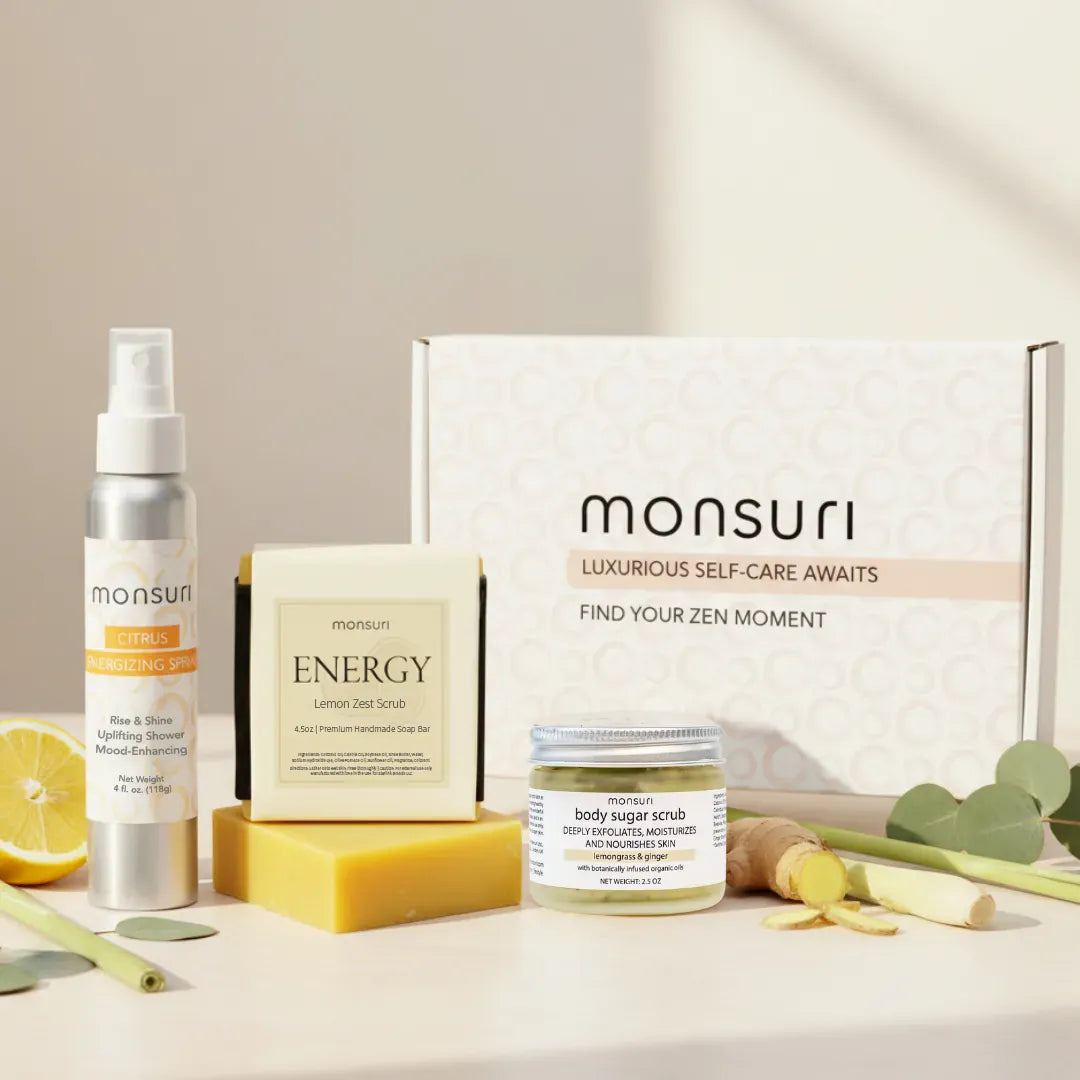
What to buy — the Monsuri Lemongrass and Ginger Sugar Scrub as the pick, the Lemon Zest Scrub Soap with sea-salt crystals for calloused heels, and the Energizing Shower Ritual set holding the sugar jar and the salt bar together.
The pick, the salt-crystal bar for heels, and the set that holds both grains. See the set that holds both grains — $52.50 →

Reviews on it are few and we would rather say so than imply otherwise — but the one that tells you the most is from a customer comparing it against the small-batch scrubs she had been buying elsewhere:

I've tried a bunch of exfoliating scrubs from Etsy and this is my favorite! Filled to the top with product and so nice on my skin.

Which is a useful thing to check on any jar you order: how much of it is product and how much is air.

If you want… Pick Price
The scrub itself — 2.5 oz to try, 5 oz for the better rate per scrub Monsuri Lemongrass and Ginger body sugar scrub jar, the two-grain sugar and poppy seed scrub, shown in the buying tableLemongrass & Ginger Sugar Scrub $16.00 / $28.00
To seal straight afterwards Monsuri Lemongrass and Rosemary whipped body butter jar, the seal step to apply after a sugar scrub, shown in the buying table Lemongrass & Rosemary Body Butter $16.00
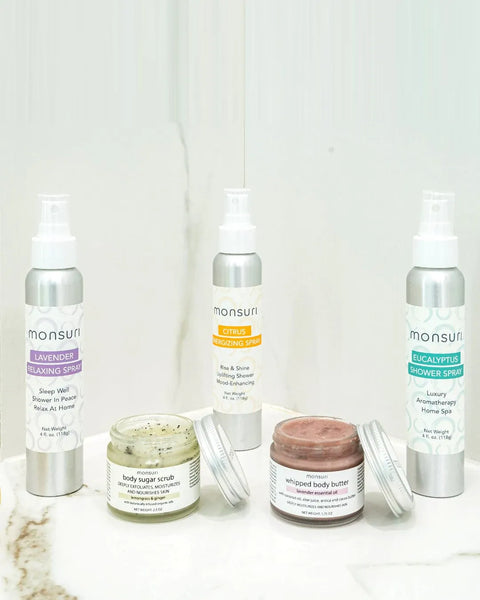
The scrub, the salt-bar soap and a morning spray Monsuri Energizing Shower Ritual Rise and Shine set holding the sugar scrub jar and the salt-crystal scrub soap, in the buying table Energizing Shower Ritual — Rise & Shine $52.50

That last row is the one to take if you already know you like a sugar scrub: it pairs the jar with the salt-crystal bar, so you have both grains for the two different jobs in section two.

The body butters and sugar scrubs sit together in one collection if you would rather compare scents side by side. Everything is picked and packed by hand from our North Salt Lake warehouse.

How often, and what to do in the next sixty seconds

Two or three times a week works for most people, and once a week if your skin reddens easily — though the honest answer is that it depends on your skin and how coarse your scrub is. The AAD's framing is the one to keep: "the more aggressive the exfoliation, the less often it needs to be done."

The step that matters most is the one straight after. The AAD is unambiguous on the general point — "apply moisturizer immediately after exfoliating" — and that is the step, whatever you use for it. An oil-based scrub leaves some oil behind, which helps, but it is not a moisturizer; follow it with a body butter while your skin is still damp. If you would rather use an oil than a butter, we compared the two in body oil before or after lotion.

Scrub then seal — the Monsuri Lemongrass and Ginger body sugar scrub jar beside a woman exfoliating, next to the Monsuri Lemongrass and Rosemary whipped body butter applied straight afterwards while the skin is still damp.
Exfoliate, then seal while you are still damp — the order dermatologists actually recommend. Shop the body butter — $16 →

For the technique itself — how much to use, how long to work it, what order to do things in the shower — our complete guide to using a body scrub picks up exactly where this one stops. And if the slow circles are the part you look forward to, aromatherapy massage extends the same idea past the shower door.

Frequently asked questions

Is a sugar scrub or a salt scrub better?

For most body skin, sugar. Sugar is water-soluble, so the crystals dissolve while you work and the abrasion tapers off on its own — it is hard to overdo. Salt keeps its edge from the first pass to the last, which makes it better on calloused heels and soles, and harsher everywhere else.

How often should you use a body sugar scrub?

Two or three times a week for most people, once a week if your skin reddens easily. The American Academy of Dermatology's rule is that the more aggressive the exfoliation, the less often it should be done, and warns that over-exfoliating leaves skin red and irritated.

Are sugar scrubs good for your skin?

Used two or three times a week on damp skin, a sugar scrub smooths surface texture and leaves oil behind so skin does not feel tight afterwards. It is a surface treatment — nothing more. Skip it on broken or sunburnt skin, and go gently if your skin is dry or easily irritated.

Does a sugar scrub leave your tub greasy?

It depends on the oil base. A scrub built on coconut oil alone turns solid below about 77°F and tends to film the tub. An emulsified scrub is formulated so the oils leave with the water instead of settling on the enamel. Either way, oil on a wet floor is slippery — mind your footing on the way out.

How long does a jar of sugar scrub last?

At two or three uses a week, our 5 oz tub runs for roughly six weeks — call it twelve to eighteen scrubs. At $28 that is between about $1.55 and $2.35 a use. That per-use figure is the honest way to compare jars, because sticker prices in this category range from about $13 to $38 across very different sizes.

Is it worth making your own sugar scrub?

For a gift or a single weekend, yes — roughly two parts sugar to one part oil works. It stops working by about week three: splash and steam get into a shower-side jar and dissolve the sugar, there is no preservative in a pantry recipe, and coconut oil sets solid in a cool bathroom.
— Scrub, then seal —

Everything for the ten minutes that change how your skin feels.

Two exfoliants and a morning spray — the sugar jar and the salt-crystal bar, for the two different jobs.

—Bundle—

The Energizing Shower Ritual

What's inside
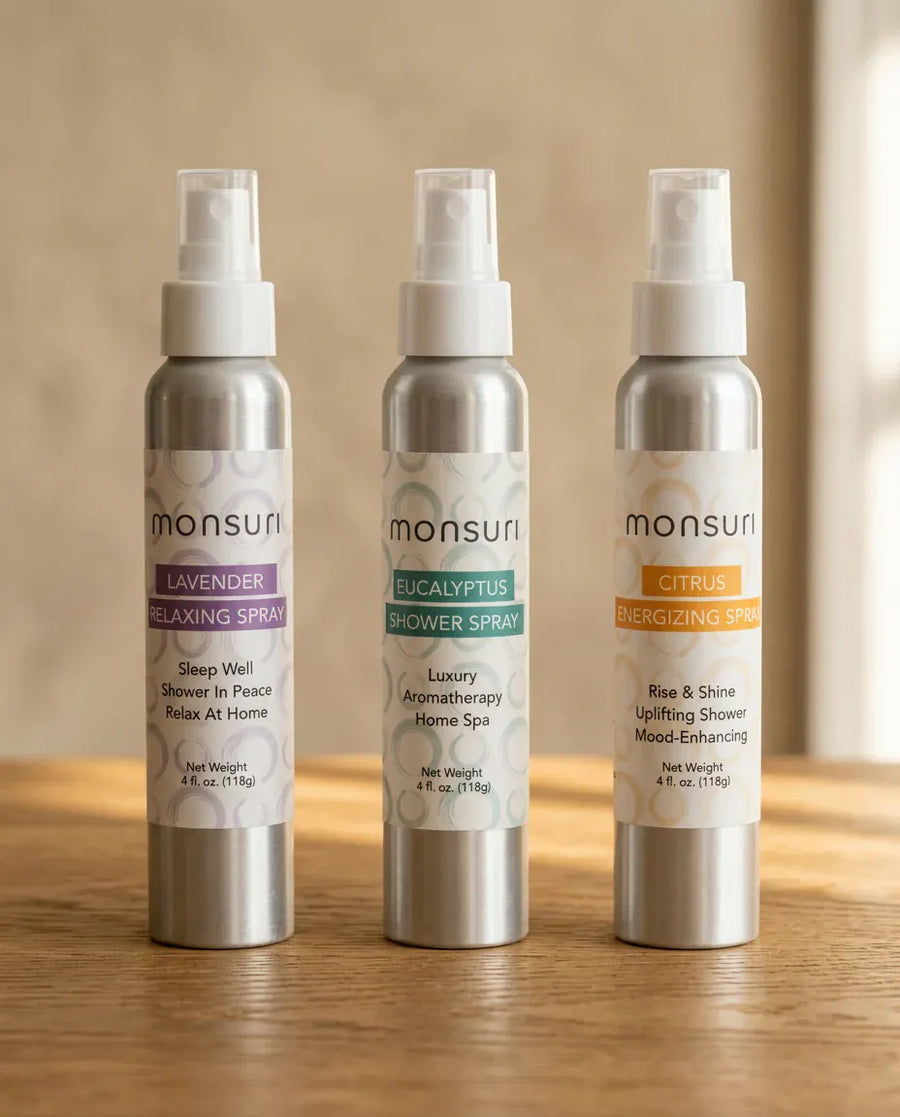
  • Sunrise Bliss Citrus Shower Spray — 4 oz spray
  • Lemongrass & Ginger Sugar Scrub
  • Energy Lemon Zest Scrub Soap — 4.5 oz bar
$52.50Three pieces · arrives in our botanical gift box
From our workshop to your bath
By Monsuri
Small-batch, made in the USA. Written without a hurry.