Your Cart is Empty







What Happens If You Put Too Much Epsom Salt In A Bath?
Epsom salt has long been a trusted go-to for everything from easing sore muscles to promoting a sense of calm. For centuries, people have turned to this magnesium sulfate to soak the day off — but how much is too much, and what actually happens if you go past it?
This guide breaks down the fine line between therapeutic and excessive use of Epsom salt, so you can get the most out of your soak without any side effects. We'll also pair the science with botanical bath soaks that work alongside Epsom salt to keep skin from drying out — the way it does after a long, plain-Epsom soak.
A "good soak" is one to two cups of Epsom salt in a standard tub of warm water, for fifteen to twenty minutes. Anything beyond that is preference, not evidence — there is no official medical dose.
So, what happens if you put too much Epsom salt in a bath? Mostly discomfort, not danger — and the short answer to the dose question is that there is no official medical amount — most packages direct 1 to 2 cups for a standard tub, and more is not stronger. If measuring by eye is how you ended up here, our Lavender Bath Soak ($18.90) is a concentrate dosed in tablespoons instead, and the rest of the bath salts & soaks work the same way. If you want the wider ritual rather than the arithmetic, start with our guide to artisan bath bombs or how to use bath salts.
- One to two cups for a standard tub is what most packages direct. Above the label range the water turns stiff and you stop noticing more benefit — only the downsides.
- Twenty minutes is the sweet spot. Long enough for absorption, short enough that the skin keeps its oils.
- 98 to 100°F is the right temperature. Hot enough to relax muscles, cool enough that the skin isn't fighting to retain water.
- The two real risks are dehydration and (very rarely) magnesium sensitivity in people with reduced kidney function. A glass of water before and after the bath solves the first one.
Why Epsom salt works
Epsom salt is magnesium sulfate — mineral crystals that dissolve in your bathwater. When they dissolve, they release magnesium and sulfate ions into the water. How much of that actually crosses the skin is genuinely contested — see the honest version two sections down — but the warm water itself does a great deal of the work people credit to the salt.
Why magnesium matters (in the body, from food): it's involved in over 300 enzyme functions in your body — muscle contraction and relaxation, nerve function, energy production, stress response regulation. Most people don't get enough from food alone.
What an Epsom salt bath does: the warm water and the ritual around it help relax tight muscles, reduces the wound-up feeling in your nervous system, and softens rough skin (elbows, heels, all of it).
What it doesn't do: pull toxins out through your skin. Your liver and kidneys handle detox. The bath helps you relax — which indirectly supports your body's natural processes — but it's not a magical detox treatment. If you want the honest version of that claim, see our actual detox bath method.

What the dose chart says: How much Epsom salt should you use? There is no official medical dose — these are the ranges packages and clinicians typically give for a standard tub of about 40 gallons (150 L), and your product label wins over any chart. The typical package range is 1 to 2 cups, which is what most Epsom salt cartons direct for a full-size tub. Cleveland Clinic guidance suggests about one and a quarter cups for a standard tub. A botanical soak is different again — a concentrate rather than bulk salt, measured in tablespoons per its own label. Soak 15 to 20 minutes in comfortably warm, not hot, water; longer doesn't add benefit and mostly dries the skin. Ask a clinician first if you are pregnant, have kidney problems, diabetes, broken or infected skin, or are soaking a child. More is not stronger: above the label's range you mostly get drier skin and a filmy tub, not a better bath.
The honest dose
Here is the first thing worth knowing: there is no official medical dose for an Epsom salt bath. What exists is a range that packages and clinicians tend to agree on, and the number on your own carton beats any chart on the internet — including ours.
Most Epsom salt packages direct 1 to 2 cups for a standard tub (roughly 40 gallons / 150 L). The Cleveland Clinic's guidance lands in the same neighbourhood, around a cup and a quarter, while also being honest that the evidence for magnesium absorbing through skin is thin. That is the honest answer to how much Epsom salt in a bath: dissolve it under running water and soak 15 to 20 minutes in comfortably warm water, and if you are pregnant, managing kidney problems or diabetes, have broken or infected skin, or are running the bath for a child, ask your clinician before you start.
The part people actually get wrong is not the first cup. It is the assumption that the second, third and fourth make the bath progressively better. They don't.
What "too much" actually means — the real Epsom salt bath side effects
The internet has two settings on this question: "Epsom salt cannot hurt you" and "Epsom salt will hospitalize you." Both are wrong.

What the what-to-do card says: You over-poured — here is the whole fix. An over-salted bath is uncomfortable, not an emergency; the usual outcome is dry, tight, itchy skin. This is general comfort guidance, not medical advice. One: get out and drain — if the water feels slippery-stiff or your skin starts to sting or itch, end the soak early; there is no benefit in waiting it out. Two: rinse with clean water — a short, cool-to-warm shower to take the salt film off your skin and hair, and rinse the tub before it dries. Three: moisturize and drink — pat dry, put oil or balm on damp skin, and have a glass of water, because warm water plus salt is drying twice over. Skip the soak entirely if you have open wounds or burns, if your skin is infected or inflamed, or if a child would be bathing unsupervised. Pregnant, or managing kidney problems, diabetes or heart disease? Ask your clinician first — the same rule as the dose card. And never let anyone drink or eat bath products. Get medical advice if skin irritation, a rash or burning does not settle after rinsing, if you feel dizzy, nauseated, weak or unusually drowsy, or if any Epsom salt or bath product was swallowed — call Poison Control. The likeliest outcome of too much is tight, itchy, dried-out skin and a film on the tub: rinse, moisturize, and use less next time.
Used at the dose above, in a healthy adult, on intact skin, Epsom salt baths are remarkably safe. The two genuine concerns are dehydration (the salt pulls water out of the skin during very long soaks) and, very rarely, magnesium sensitivity in people with reduced kidney function. A 2016 PubMed study on magnesium sulfate confirmed that magnesium does permeate skin in warm water — but only via hair follicles, and at modest rates. (Chandrasekaran et al. 2016, Magnesium Research) Cleveland Clinic's published view is more skeptical still: "there are no definitive studies showing that magnesium can be absorbed through your skin in sufficient amounts to address potential deficiencies of the mineral." (Cleveland Clinic, Should you take an Epsom salt bath?) Translation: an Epsom bath helps tight muscles and a wound-up nervous system, but it's not a magnesium IV. Eat magnesium-rich foods if you want sustained levels.
Who should not use Epsom salt baths: anyone with reduced kidney function, severe heart disease, open wounds, severe burns, or pregnancy without your provider's blessing — and children, whose dosing is a question for a pediatrician rather than a chart. When in doubt, ask your doctor — not us, and certainly not a forum.
If your skin feels tight or itchy, you're using too much or soaking too long. Cut the dose, shorten the bath, and moisturize while still damp.
How long to soak in an Epsom salt bath — and how often
Three numbers do most of the work. Twenty minutes is the sweet spot — long enough for the warm water to do its work, short enough that the skin keeps its oils. 98 to 100 degrees Fahrenheit is comfortable-warm, not strip-the-paint hot. Two to three times a week is plenty.
More than that and the bath becomes a habit you owe rather than a ritual you keep.
- Duration: 15–20 minutes is the therapeutic window. 30 is the ceiling.
- Temperature: 98–100°F (37–38°C). If you can read in it, it's the right temperature.
- Frequency: 2–3 times a week. Daily is the body asking for something else.
- Hydration: A glass of water before, a glass after. Not optional.

Customizing your bath for what you need
Plain Epsom salt is medicine. Botanically infused soak is the bath you actually want to take. The difference is small in chemistry and enormous in feeling.
For muscle recovery — combine Epsom salt with eucalyptus or peppermint to ease soreness post-workout. The magnesium relaxes tight muscles; the aroma extends the recovery.
For skin soothing — if your skin feels dry or irritated, use a soak that pairs Epsom with botanicals like calendula and St. John's wort. Follow up with body oil while still damp.
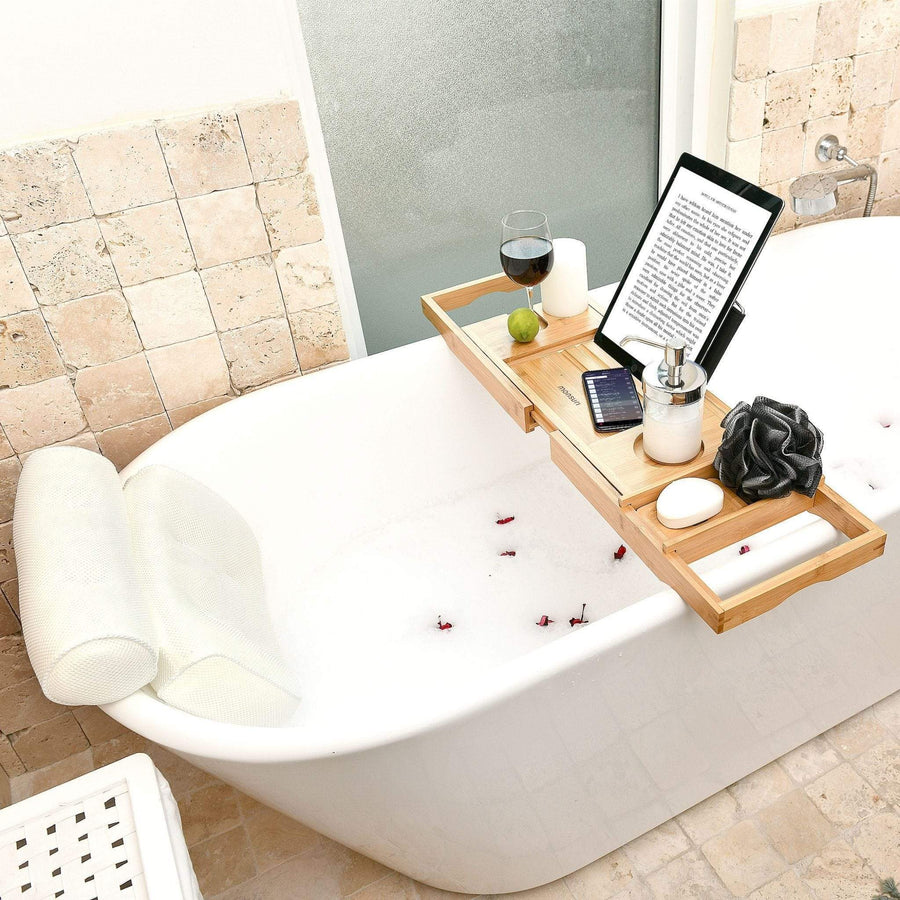
For stress relief — recreate the calming vibe of a spa with lavender, a dim lamp, and the agreement to put your phone in the other room. The magnesium helps the muscles let go; the warm water settles the nervous system.

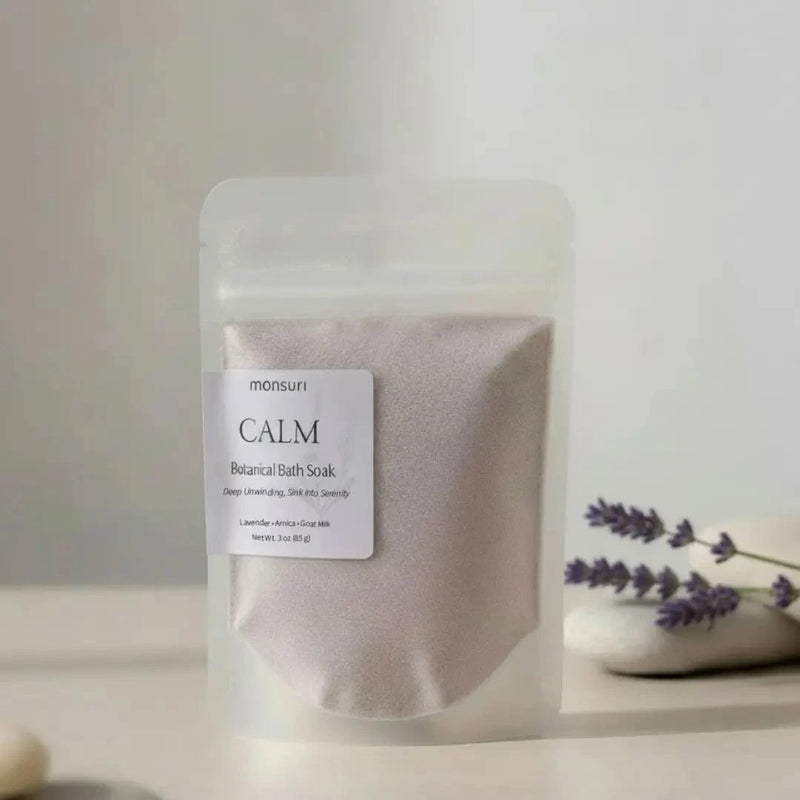
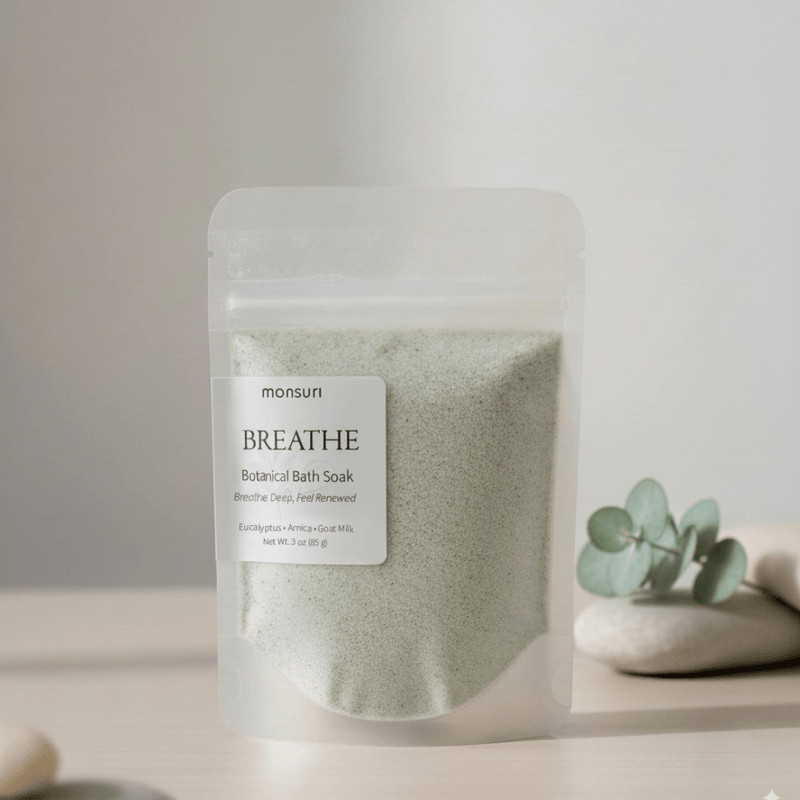
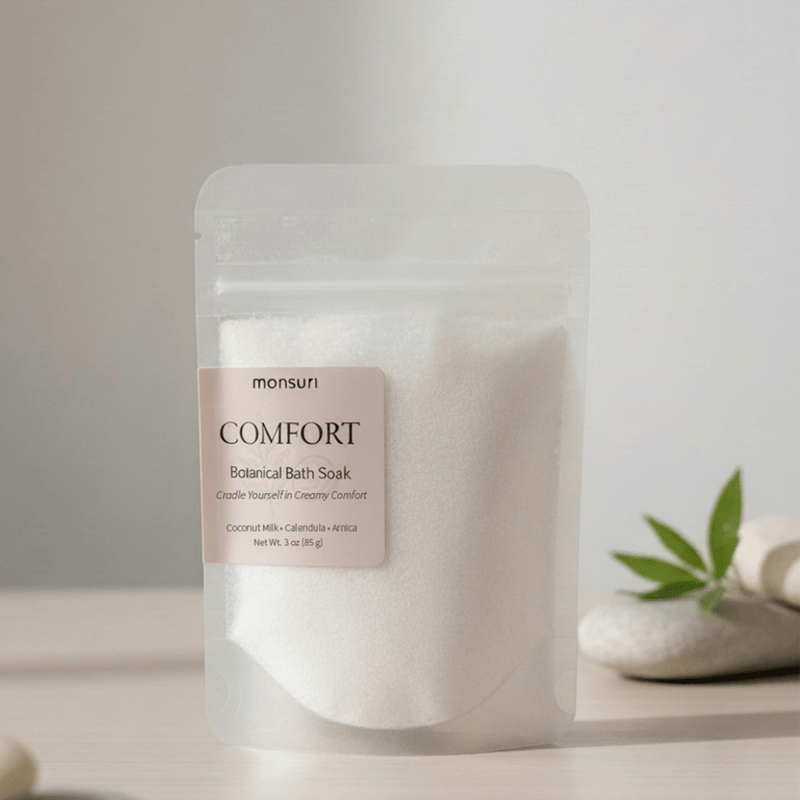
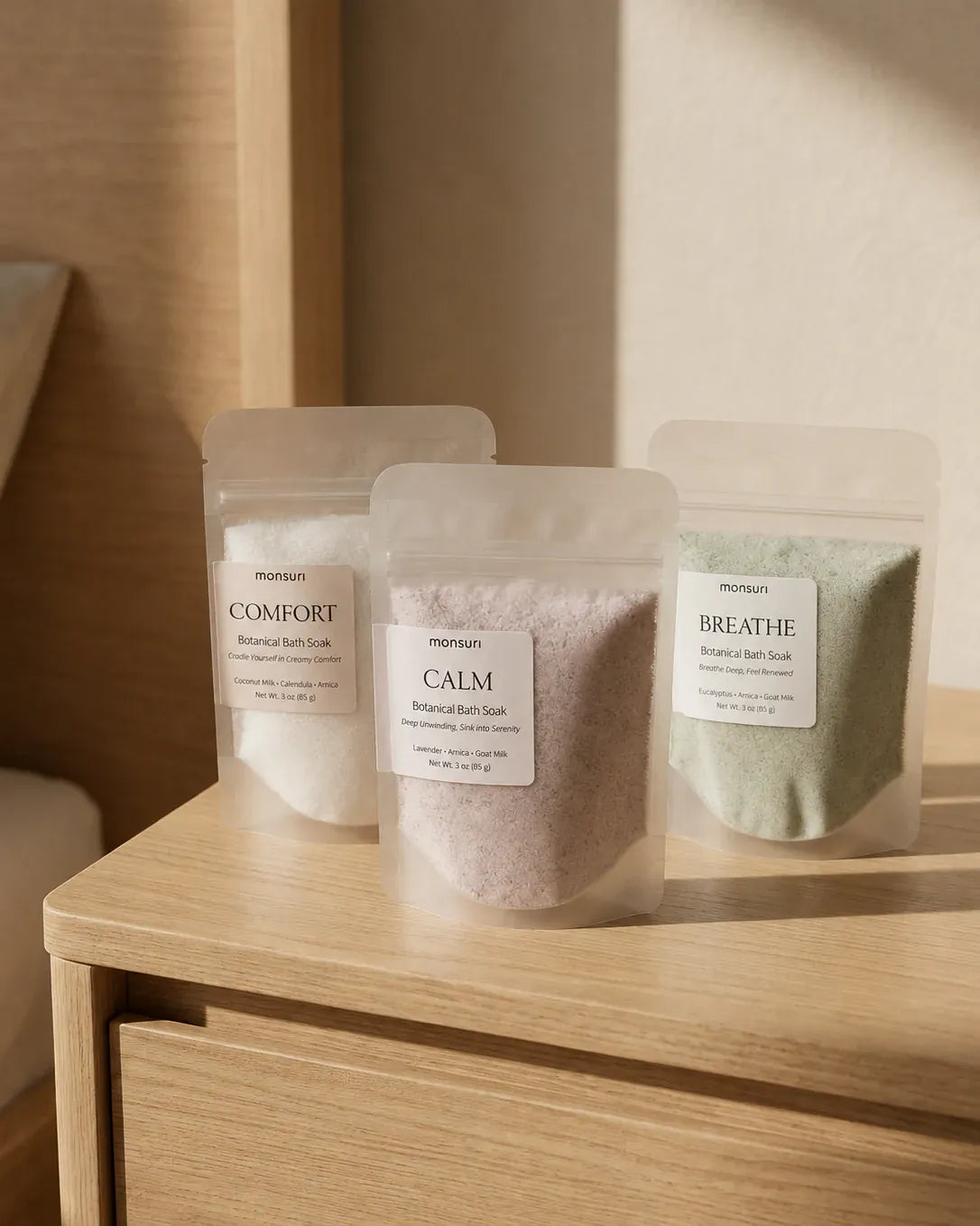
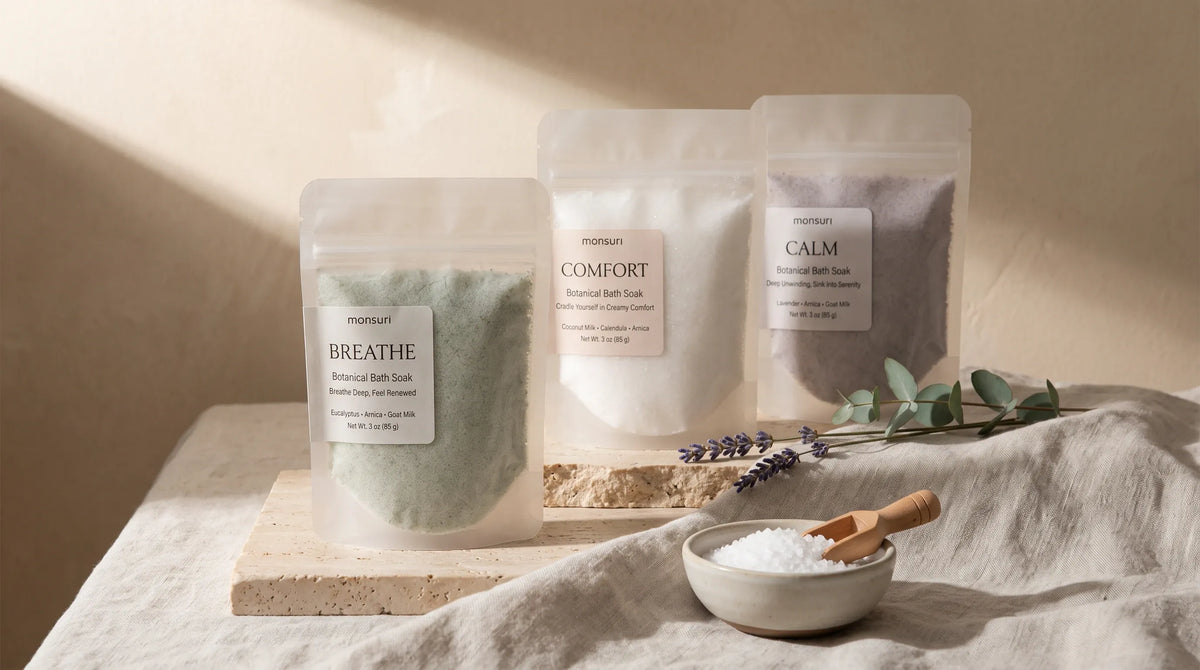
If measuring bulk salt by eye is how you ended up here, a soak that doses in tablespoons is a different way to run the bath. Each pouch is 3 oz (85 g), uses 1–2 tablespoons per tub, and lasts two to four baths — and unlike plain Epsom salt, the water gets goat or coconut milk and the calendula-arnica infusion with it.
| Soak | Price | Run it when | |
|---|---|---|---|
 |
Lavender Bath Soak | $18.90 | Lavender + arnica, goat milk. The evening wind-down bath — the one to start with if you only buy one. 3 oz, 2–4 baths. |
 |
Coconut Milk Bath Soak | $18.90 | Coconut milk + calendula. For when the last bath left your skin tight — the softest of the three. 3 oz, 2–4 baths. |
 |
Eucalyptus Bath Soak | $18.90 | Eucalyptus + arnica. The clear-the-head bath, for a heavy or stuffy day. 3 oz, 2–4 baths. |
 |
All three, as a set | $53.70 | Try all three blends before committing to one — and a genuinely good gift for someone who runs hot baths. |
Side effects to watch for
While most people enjoy Epsom salt baths without issue, soaking with too much salt or for too long can lead to discomfort. Here's what your body might say if you've gone past the dose:
- Dry or itchy skin: the most common signal. Especially if you skip moisturizing afterward.
- Mild irritation: redness or a tight feeling, usually from soaking with the salt undiluted.
- Lightheadedness on standing: dehydration. Drink water before and after the bath.
If any of these show up, the answer is simple: cut the dose in half next time, shorten the soak by ten minutes, and moisturize while skin is still damp. The bath should leave you feeling better — not like you owe your skin an apology.
The 20-minute version
If you only remember one paragraph from this entire article, make it this one.
Run the bath warm — comfortable, not hot. Add two cups of Epsom salt as the tub fills, so it dissolves with the current. Step in. Settle. Drink the water you brought with you. Read, or don't. Step out at twenty minutes, pat dry, do not rinse the salt off — let it keep working through the night. Apply body oil while skin is still damp.
That's the whole thing. The rest of the article was just permission to do less.

A word from our workshop
Plain Epsom is medicine. Botanically infused Epsom is the bath you actually want to take. The botanicals we infuse — dried lavender, eucalyptus, chamomile, calendula, St. John's wort — are steeped into the salt before packing, so the oils dissolve when the water hits. Nothing floats, nothing clogs the drain, nothing feels like a science experiment.
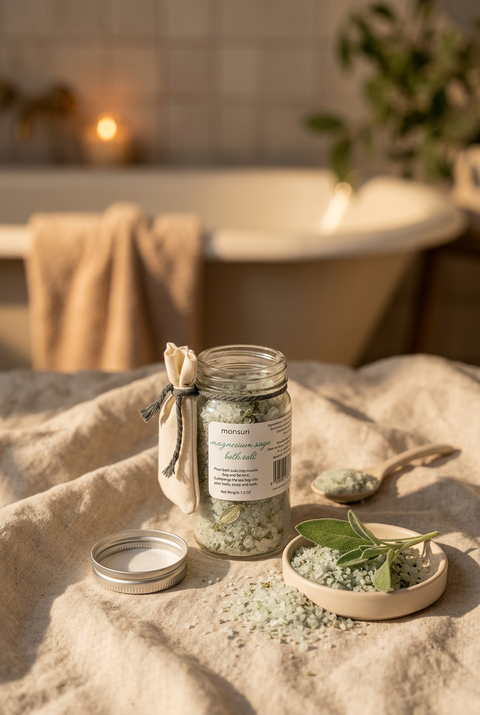
Start with the Magnesium & Sage Bath Salts if you want the pharmaceutical-grade Epsom in therapeutic ratios with sage botanicals layered in. Or move to the soak that matches what your body's asking for — Lavender for stress, Eucalyptus for muscle recovery, Coconut Milk for hydration. The bath, in our small opinion, is the last private thing left. We're trying to make it worth the twenty minutes.