Your Cart is Empty







How to Use Body Scrub for Smooth, Glowing Skin: The Ultimate Guide
Used right, a body scrub buffs off dull skin in 60 seconds per zone, makes the lotion that follows actually absorb, and leaves skin feeling smoother for three to four days. Used wrong — too often, too hard, in the wrong order or water temperature — it strips lipids, irritates, and makes skin look duller than it did before you started. Here is the 5-step protocol the rest of this article unpacks: cleanse with body wash first, scrub with a walnut-size dose on damp (not soaking) skin, 60 to 90 seconds of gentle circular work per zone, rinse with lukewarm water, then seal moisture inside a 60-second window with body oil or butter. Twice a week. That's the whole thing.
1. What a body scrub actually does to your skin
A body scrub is a leave-on-for-90-seconds, rinse-off exfoliant. The active ingredients are abrasive particles — cane sugar, sea salt, ground apricot seed, coffee, or a mix — suspended in an oil or emulsion base. As you massage it on, the particles physically lift the layer of dead skin cells (the stratum corneum) that has stopped reflecting light and started absorbing your moisturizer instead of letting it pass through.
The American Academy of Dermatology covers the mechanism cleanly: exfoliation removes dead cells from the surface of the skin, which improves skin tone and helps other products penetrate deeper. The key word is surface. A body scrub is not meant to scrub away anything alive. If your skin is red, raw, or stinging afterward, you're scrubbing too hard, too often, or both.
Three things happen mechanically when you scrub correctly:
- Dead-cell removal. The outer 15 to 30 microns of stratum corneum that look matte and dull come off, revealing the layer underneath that still reflects light.
- Circulation lift. The 60 to 90 seconds of circular pressure brings a small wave of blood to the surface — the same reason your skin pinks up after a hot shower. That's the “flushed glow” in before-and-after photos.
- Lipid layer disruption. Exfoliation removes about 30 to 40 percent of the surface lipid film along with the dead cells. That's why sealing within 60 seconds matters — without the seal, water evaporates faster than usual and you end up drier, not glowier.
Different scrub types serve different purposes, and matching the right one to your skin is most of the work:
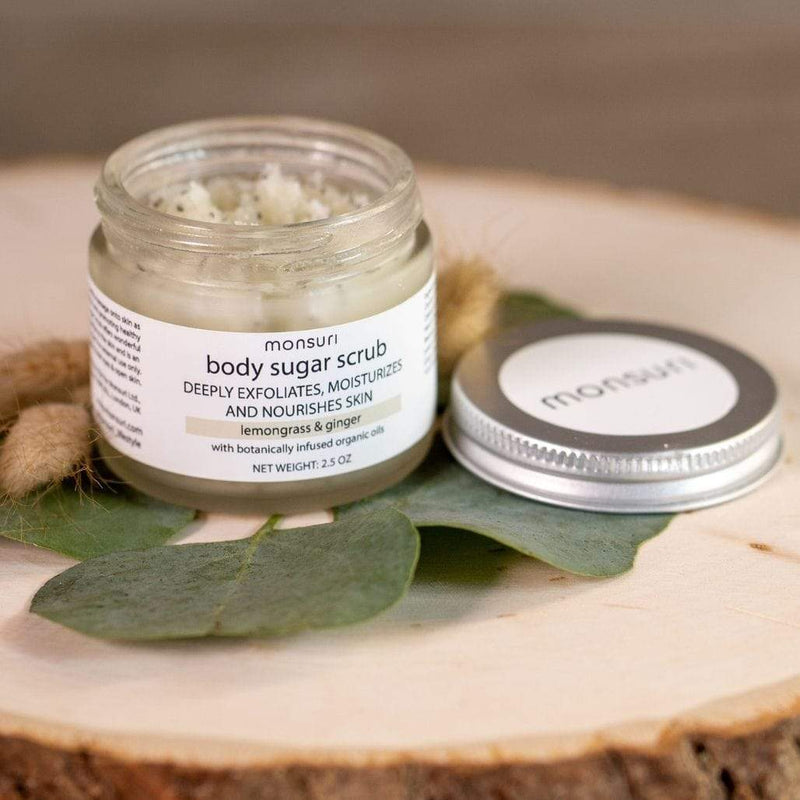
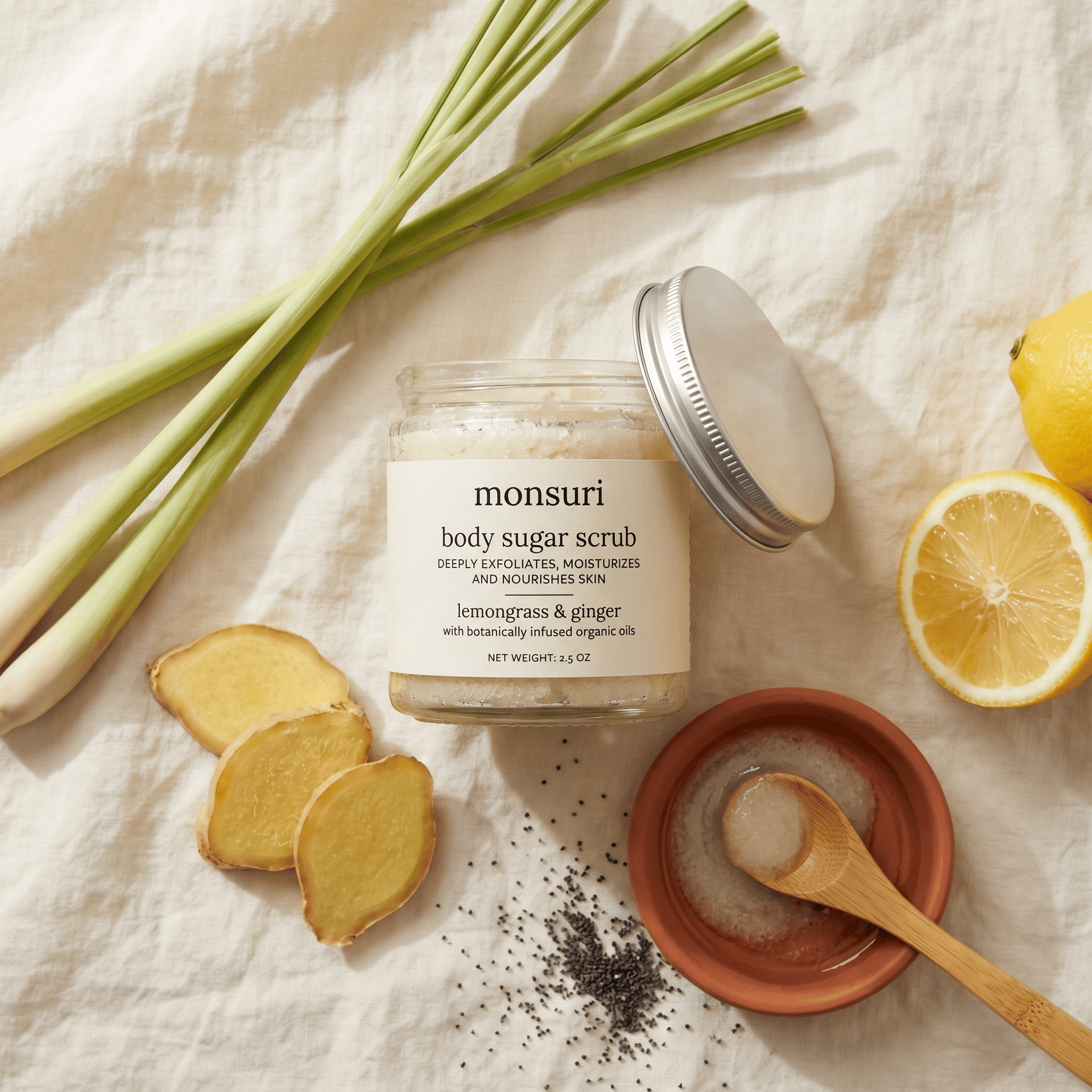
- Sugar scrubs — cane-sugar crystals dissolve as you work them in. The most forgiving choice for sensitive or dry skin. The Monsuri Lemongrass & Ginger Sugar Scrub sits here.
- Salt scrubs — coarser, more abrasive, better for rough zones like feet and elbows. Too sharp for the chest or inner arms.
- Coffee scrubs — medium-coarse with caffeine, marketed for circulation. Decent for the back of thighs; messy in a shower.
- Chemical exfoliants (AHA / BHA body washes) — dissolve dead cells without abrasion. A good alternative if even sugar irritates you.
For the rest of this guide, every instruction works for sugar and salt scrubs equally well unless otherwise noted.
2. How to use a body scrub — the 5-step shower protocol
This is the procedure dermatologists, estheticians, and the back-of-the-jar instructions all converge on. The version below is the one we use ourselves and what is encoded into the HowTo structured data at the bottom of this page.

-
Step 1 — Cleanse with body wash first. Stand under the shower for 60 seconds to soften the stratum corneum. Wash with a gentle body wash to remove sweat, oil, and the day's debris. You want a clean canvas before you exfoliate; otherwise you're driving dirt and oil into the same pores you're trying to clear.
-
Step 2 — Turn the water off, or step out of the stream. You don't want to scrub under running water — the particles wash off your hand before they reach your skin. Skin should be damp, not soaking. (If you're using a dry-brush method on knees, feet, or elbows specifically, skip the wet phase for those zones.)
-
Step 3 — Scoop a walnut-size dose and work it into one zone at a time. About a tablespoon per leg, per arm, per side of the torso. Move in gentle, overlapping circles for 60 to 90 seconds. Use featherlight pressure on the chest, neck, and inner arms; slightly firmer on knees, elbows, feet, and the backs of upper arms (the “keratosis pilaris triangle”). Stop the second you feel any sting.
-
Step 4 — Rinse with lukewarm water, not hot. Hot water strips lipids. Lukewarm rinses the particles cleanly and keeps the moisture barrier you just exposed intact. Finish with a 10-second cool rinse to close the pores down. This is also when you do the second body-wash pass if you want to make sure no oily residue is left for your towel to catch.
-
Step 5 — Seal within 60 seconds. Step out, pat (don't rub) with a towel, and apply body butter or body oil while the skin is still damp. The damp layer of water on the surface acts as a vehicle — the emollient traps it under a thin lipid film and that's what makes skin look glowy two hours later instead of just clean.
3. Body scrub before or after body wash? Here's the order, and why
Body wash first. Scrub second. Always.
The reasoning is straightforward: a body scrub works on the surface of your skin, lifting off dead cells with abrasion. If that surface is still coated in sweat, sunscreen, deodorant residue, and the day's general grime, the scrub particles end up exfoliating the grime, not the skin. The work that should be the third pass of your shower becomes the second, and you've wasted the dose.
There's one exception worth naming: a small number of premium “cleansing scrubs” (Monsuri's Lemon Zest Scrub Soap is one) bundle the cleanser into the scrub. Those are designed to be used as the only product in the shower — lather, exfoliate, rinse, done. If the label says it's a 2-in-1, follow the label. If it just says “scrub” or “sugar scrub” or “salt scrub”, do the body wash first.
If you're following this on a salt-scrub day specifically, the rinse afterward should be more thorough — salt residue absorbs moisture and any left behind will pull water out of your towel before it pulls it out of your skin.
4. How often you should use a body scrub (without over-exfoliating)
The honest answer is: less often than you think. The same AAD guidance notes that over-exfoliation is one of the most common skincare mistakes — it presents as red, irritated, or peeling skin, the very opposite of the glow you were after.
The frequency that works for almost everyone:
| Skin type | How often | What to watch for |
|---|---|---|
| Normal | 2 to 3 times per week | Glow lasting 3 to 4 days, no redness |
| Dry | 2 times per week (always seal step is non-negotiable) | Tightness within 30 minutes = scaling back to 1× |
| Oily / acne-prone | 2 to 3 times per week | Don't use on actively-broken-out zones; wait for them to heal |
| Sensitive | 1 time per week, sugar scrub only | Stinging, redness lasting >5 minutes = stop completely for 2 weeks |
| Mature (50+) | 1 to 2 times per week | Skin recovers more slowly; longer gap between sessions wins |
| Keratosis pilaris zones (upper arms, thighs) | 3 times per week, sugar scrub, gentle pressure | Bumps fade gradually over 4 to 6 weeks of consistent use |
If you're not sure where you land, start at twice a week, seal religiously, and add a third session in week three only if the first two are leaving your skin happy. There is no version of “every day” that ends well.
5. Wet skin or dry skin? When each works better

The conventional wisdom — that body scrubs are always for wet skin — is almost right, but the “almost” matters.
- Damp skin (the default) — gentler exfoliation, easier to spread the dose evenly, particles travel further on the surface. This is the right answer for sugar scrubs on most of the body.
- Dry skin (for rough zones only) — knees, elbows, heels, and the soles of the feet. The same dose on dry skin exfoliates 30 to 40 percent more aggressively because there's no water film to cushion the friction. Mayo Clinic's skin-care basics mention dry exfoliation as the harsher of the two — reserve it for the four zones where harsher is what you want.
The hybrid version that works on a Sunday: scrub knees, elbows, and feet on dry skin in the first 30 seconds of the shower; turn the water on; scrub everywhere else on damp skin per the protocol in §2.
6. The 60-second seal window — why most people skip the part that actually delivers glow
Here is the operational detail every body-scrub article skips and every esthetician will tell you: the seal step is the one that makes the difference between “smoother” and “glowing.”
Mechanically: when you finish rinsing, your skin is holding a thin film of water on the surface. That water has been buffered by what's left of your lipid layer (you stripped 30 to 40 percent of it; the remaining 60 to 70 percent is what keeps the rest in). If you let that film air-dry, the water evaporates and takes some of the remaining lipids with it — this is called transepidermal water loss, and it's the single biggest reason post-scrub skin can feel tighter, not softer.
The fix is to lock that water in before it evaporates. The 60-second window is the practical bound — after a minute, most of the surface water is gone and you're applying butter or oil to dry skin, which is fine but no longer vehicled. Within that window, the emollient pulls the water into the skin and traps it. That's the difference you see two hours later in the mirror.
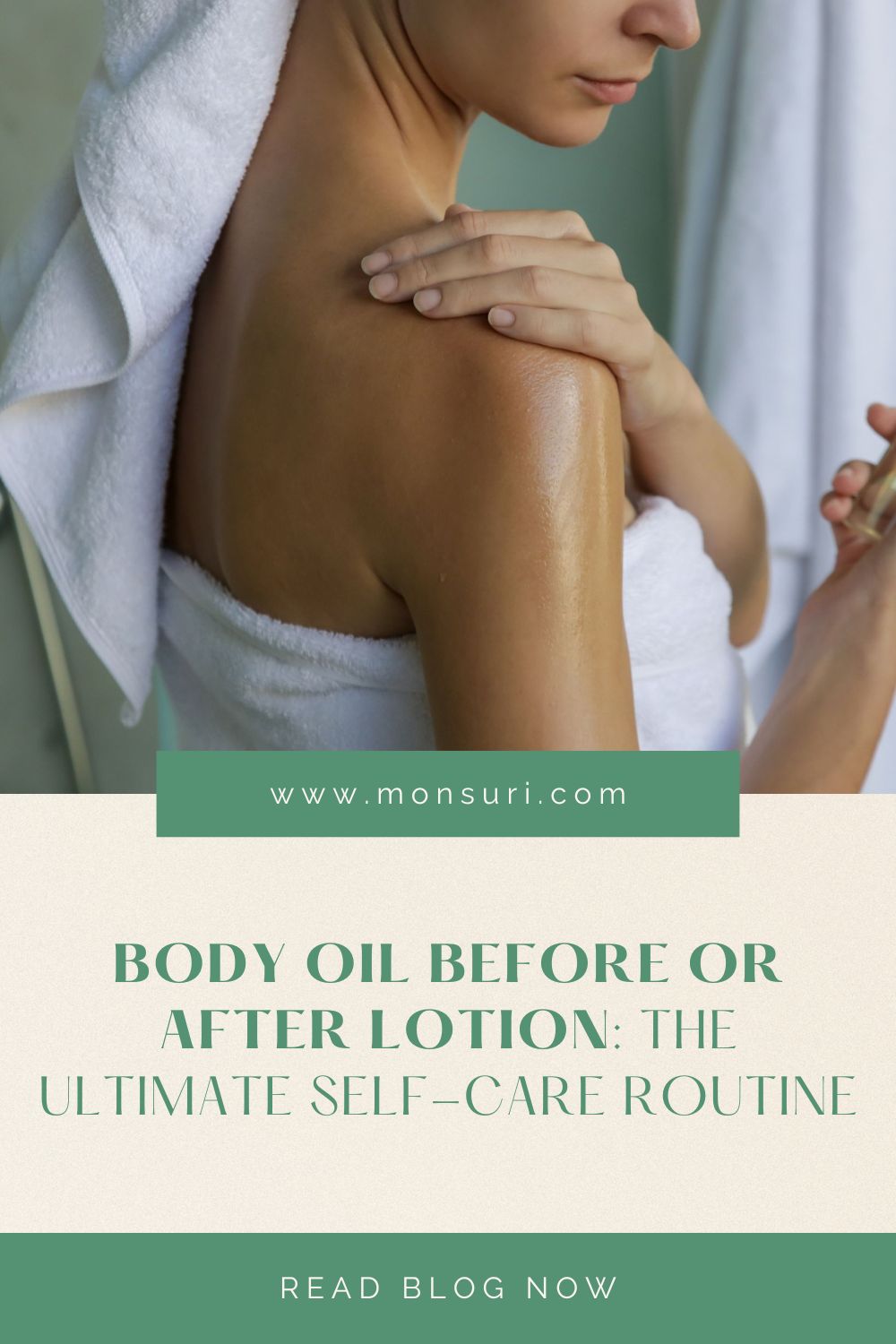
Sister article: Body oil before or after lotion goes deep on which seal medium to choose by skin type and time of day. For the 5-second version — body butter for dry skin and evenings, body oil for normal-to-oily skin and mornings.
7. How to use a body scrub for shaving, glow, and pre-event prep
For shaving
Scrub the area you're about to shave 30 seconds before you do. The exfoliation lifts the small hairs and clears the dead-skin around each follicle, which is what causes ingrown hairs after a close shave. Rinse, then shave with the grain, then rinse again, then seal. Don't scrub after shaving — the skin is freshly micro-abraded and any additional abrasion in the next 12 hours irritates rather than smooths.
For pre-event glow (wedding, photo, vacation morning)
Start a week out. Three sessions across seven days, spaced 48 hours apart. On the morning of, scrub a final time in the shower, follow the 5-step protocol religiously, and seal with a hydrating oil rather than butter (oil sits flatter under makeup or clothing).
For the routine glow that doesn't need an event
Pair the scrub with a glow-oriented body oil two to three times a week, and a body butter every night. Within four weeks, skin tone evens out (the keratosis-pilaris triangle on the upper arms responds especially well), and the glow stops being something you produce for events and starts being the default.
8. Can you use a body scrub on your face? Why estheticians say no
No. Facial skin is roughly half as thick as the skin on your body, the lipid layer is more delicate, and the particle size that's gentle on a knee is sharp on a cheek. The most common consequence of using a body scrub on the face is barrier damage — tiny micro-tears that you can't see but that cause stinging when you apply anything for the next 48 hours.
If you want the same benefit on your face, use a dedicated facial exfoliant. Either a chemical option (AHA or BHA at low concentration), or a finely-milled physical exfoliant labeled specifically for the face. The few hundred dollars saved by “one product, head to toe” isn't worth the barrier you'll spend the next month repairing.
9. The Monsuri Lemongrass & Ginger Sugar Scrub — and why this exact one
Most of this article applies to any scrub you already own. The reason to mention ours specifically is that the formula is tuned to forgive the two most common mistakes people make — pressing too hard, and scrubbing too often.
- Finely milled cane sugar dissolves as you work it in, which means the abrasion ramps down through the 60- to 90-second window. By the rinse, you're working with a soft slurry, not a sharp grit. That's why we can pass it for “sensitive skin once a week” without flinching.
- Grapeseed and house-infused coconut oil (arnica, calendula, comfrey, St. John's wort steeped at the studio) form the base. This is why you don't need a separate body oil after if you're in a rush — the rinse leaves a thin film already.
- Lemongrass and ginger essential oils bring antibacterial + circulation-lifting properties without being so loud they linger past the shower. The scent is sharp, citrusy, and gone by the time you've toweled off.
- Poppy seeds for the rough zones — they give you the option to press a little harder on heels and elbows without scaling up to a salt scrub.
- Vitamin E + paraben-free preservative system — the jar lasts about three to four months at twice-weekly use without separating, which is the practical bound on a non-preserved DIY recipe.
The 2.5 oz jar is $16 and lasts about six to eight weeks. The 5 oz jar is $28. Most buyers settle into the 2.5 oz as a regular and add a body butter or body oil for the seal step.
→ Shop the Lemongrass & Ginger Sugar Scrub

10. The Skin-Glow Ritual: pair it with a body butter or oil to lock the work in
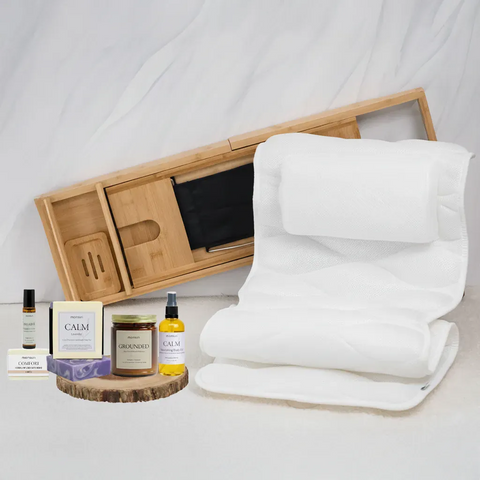
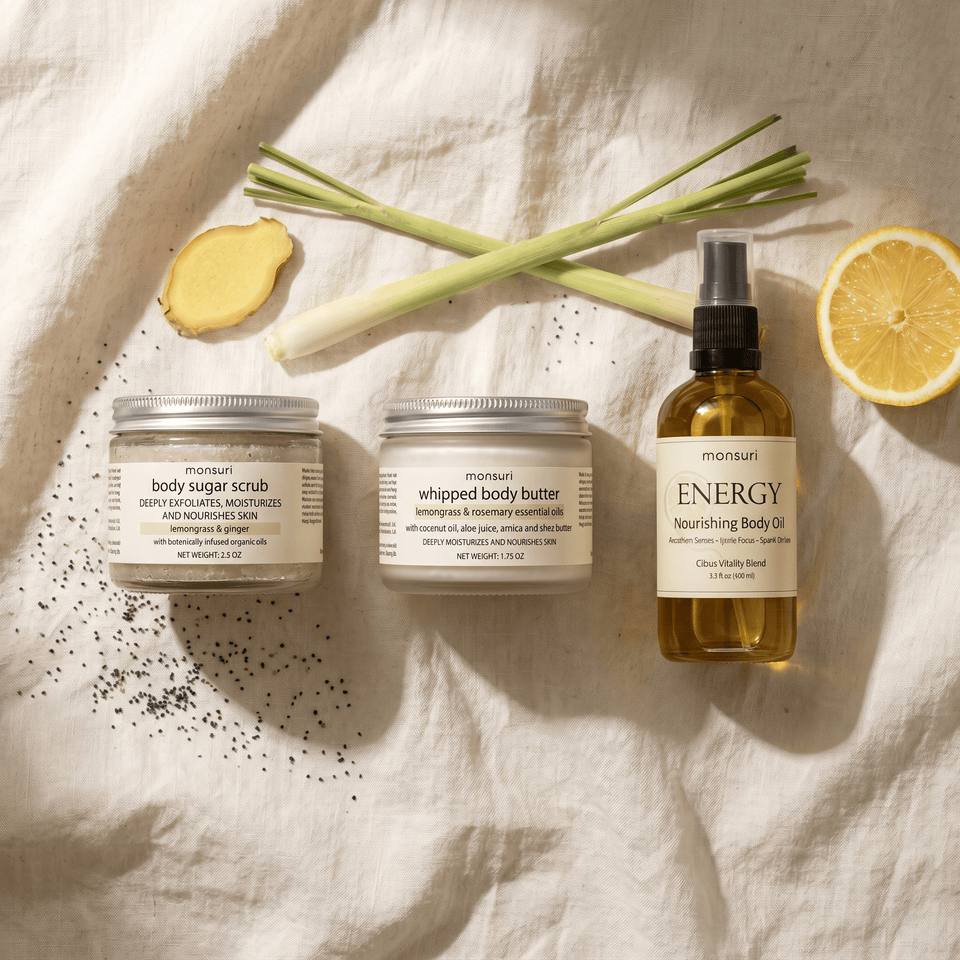
If you've read this far you know the seal step is the one that makes or breaks the result. The Skin-Glow Ritual is the three-piece kit we recommend to anyone starting out: the scrub for the exfoliation pass, the body butter for evenings, and the body oil for mornings or under makeup. The three together cover every variation of the protocol in this article.
- Lemongrass & Ginger Sugar Scrub — 2.5 oz — the exfoliation step.
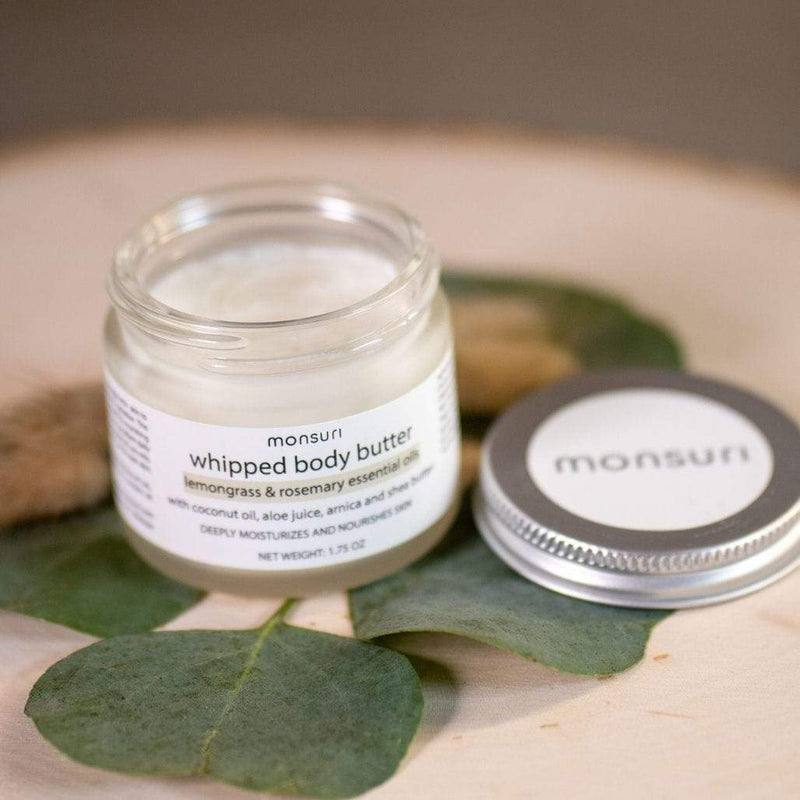
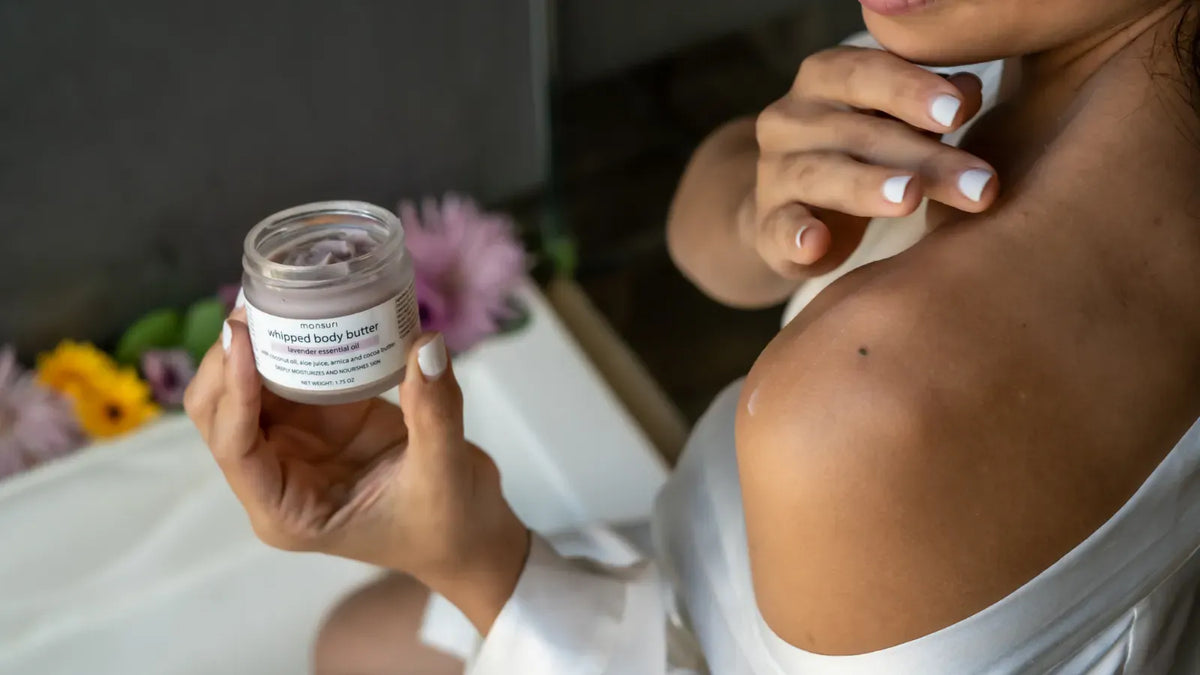
- Lemongrass & Rosemary Body Butter — 1.75 oz — the evening seal step. Scent matches the scrub.
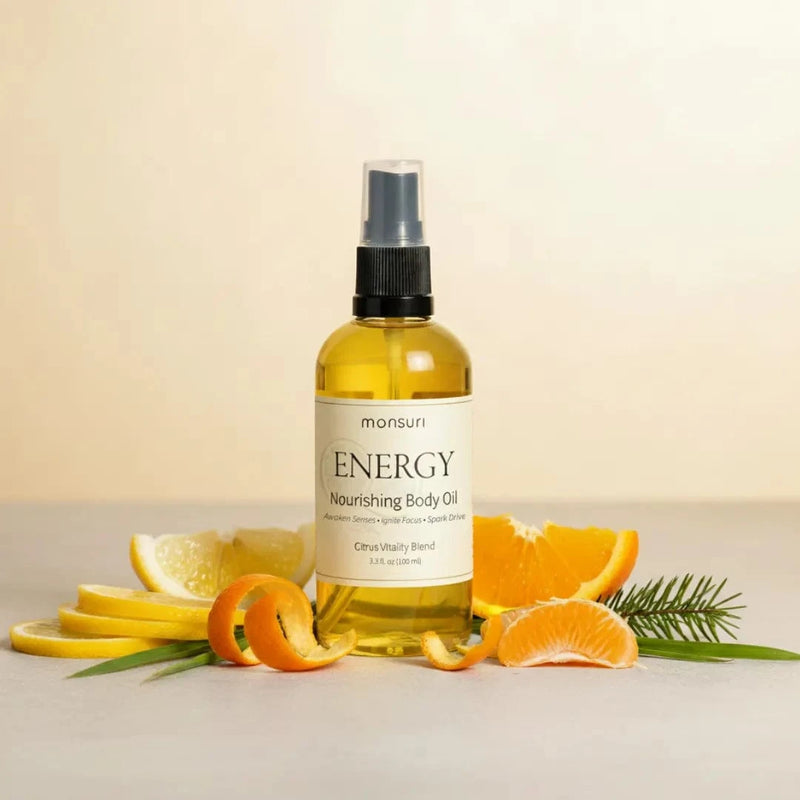
- Energizing Body Oil for Morning Vitality — the morning seal step. Lighter texture, citrus-forward, sits under clothes without showing.
Three SKUs at $59 full price. (The bundle ships at retail — no discount — the scrub-to-seal pairing is the value.)
For the deeper read on why oil-versus-butter matters by skin type: our body-oil-before-or-after-lotion guide covers it in operational detail. For the broader bath-and-body ritual frame — how scrubbing fits into the larger Sunday-evening reset — the ultimate self-care aesthetic read maps the full sequence. If you want the wider scrub primer (sugar vs salt vs coffee), the exfoliating body and sugar scrubs guide goes one layer deeper on chemistry.